Kerala’s own Dr Kotnis: The doctor who takes humanity to world’s war zones
Where should we go after the last frontiers?
Where should the birds fly after the last sky?
Where should the plants sleep after the last breath of air?
- (Mahmoud Darwish, 1995)
Do you know that China commemorates the memory of an Indian doctor every year? He was Dr Dwarakanath Shantaram Kotnis (1910-1942), a physician from Maharashtra who spent most of his life in China. Dr Kotnis is among the ancestors and national heroes China honours during the annual Qingming festival (somewhat akin to our Karkadaka Vavu), an annual function to commemorate the ancestors. During Qingming (Tomb-sweeping Day), Chinese families visit the tombs of their departed elders to clean the gravesites and make ritual offerings. Dr Kotnis was part of the five-member Indian Medical Mission sent in 1938 to China to tend to the wounded soldiers in its resistance against the invading Japanese army.
The mission followed a request from Chinese Communist General Zhu De to Jawaharlal Nehru and was sent at the initiative of Netaji Subhash Chandra Bose. Kotnis and his colleagues became heroes for their dedication, braving extreme dangers, shortages and other hardships imposed by war. Even after the other four members returned to India later, Kotnis stayed on. He married a Chinese woman and continued serving the poor and the sick until he passed away when he was barely 32. Immortalised by director V. Santaram in the film, Dr Kotnis Ki Amar Kahani (1946), Dr Kotnis has long remained a symbol of friendship between India and China.
I remember Dr Kotnis now because contemporary Kerala has a Dr Kotnis of its own. He is Dr S S Santhosh Kumar, an orthopaedic surgeon and specialist in emergency medicine from Thiruvananthapuram, who has arguably done something virtually unparalleled among Malayalis-and perhaps Indians. Over the last 22 years, he has voluntarily served victims of wars, epidemics, civil strife, ethnic conflicts or natural disasters in more than 40 countries.
On leave from Kerala government’s medical service, Dr Kumar presently serves as the Director of the Project HOPE under the United Nations and shuttles between Gaza and Ukraine, where wars continue to rage with no relent. Earlier, Kumar was the South Asia Director of the famous Doctors without Borders, the Paris-based international medical humanitarian organisation also known as Médecins Sans Frontières (MSF), which delivers emergency aid in conflict zones and disaster-hit regions.
The extreme suffering Kumar has witnessed -and at times personally endured-, or the multiple occasions when he escaped danger by a whisker while his colleagues around him were killed, have earned him a very special place in Malayali’s long tradition of selfless public service. According to Kumar, the most chilling and brutal sights that he has witnessed were in Gaza, where he spent 250 days in four separate visits from November 2023 until last April, following his 18-month-long stint in Ukraine.
“I was conducting operations alongside my colleagues in the Emergency room on the ground floor of Gaza’s Nazar Hospital when Israeli missiles fell on its terrace, which destroyed most of the hospital, including the ICU. We escaped only because we were on the ground floor. I saw about 30 persons, including many who had worked with us, breathing their last in the attack,” he recalls. Kumar and other doctors spent nights in ICUs, as there was no accommodation. With drinking water scarce, they themselves had to consume IV fluids. Kumar had contracted hepatitis while in Gaza.
Gaza, lying on the Mediterranean coast, is one of the world’s oldest continuously inhabited cities, dating back to the 15th century BC. It was Palestine’s most populous city until the current invasion began in October 2023, with nearly six lakh people. Today, devastated by the ongoing Israeli assault, hundreds of thousands of Gaza people have been displaced, and many thousands have been killed or maimed. From North Gaza to Khan Yunis in the South, most parts of the coastal enclave have been rendered uninhabitable by sustained bombardment. Only those who have absolutely nowhere else to go have remained.
As of May, according to Wikipedia, at least 75,811 persons (of which about 74000 are Palestinians and 2050 Israelis) have been killed since Israel’s invasion. It says that 70% of the Palestinians killed in bombings and missile attacks on residential buildings were women and children. Among the killed are 270 media workers, 120 academics and over 560 humanitarian aid workers. A recent UN inquiry led by Justice Muralidhar points out that the worst sufferers of the Israeli invasion are the children.
But as Dr Kumar points out, only the number of the dead and seriously wounded reach the outside world. What one encounters inside Gaza is a much larger human catastrophe. He speaks of arson, looting and violent clashes between gangs fighting over increasingly scarce food and drinking water; diseases spreading through contaminated water; grievously overcrowded hospitals where the injured including women and children being operated on without even necessities like anaesthesia; children being hacked by adults to snatch food packets from them; streets overflowing with human excreta; orphaned children scavenging through heaps of garbage; over 1500 persons compelled to share a single toilet with hundreds waiting in queues and those who could no longer bear, relieving themselves on street sides.
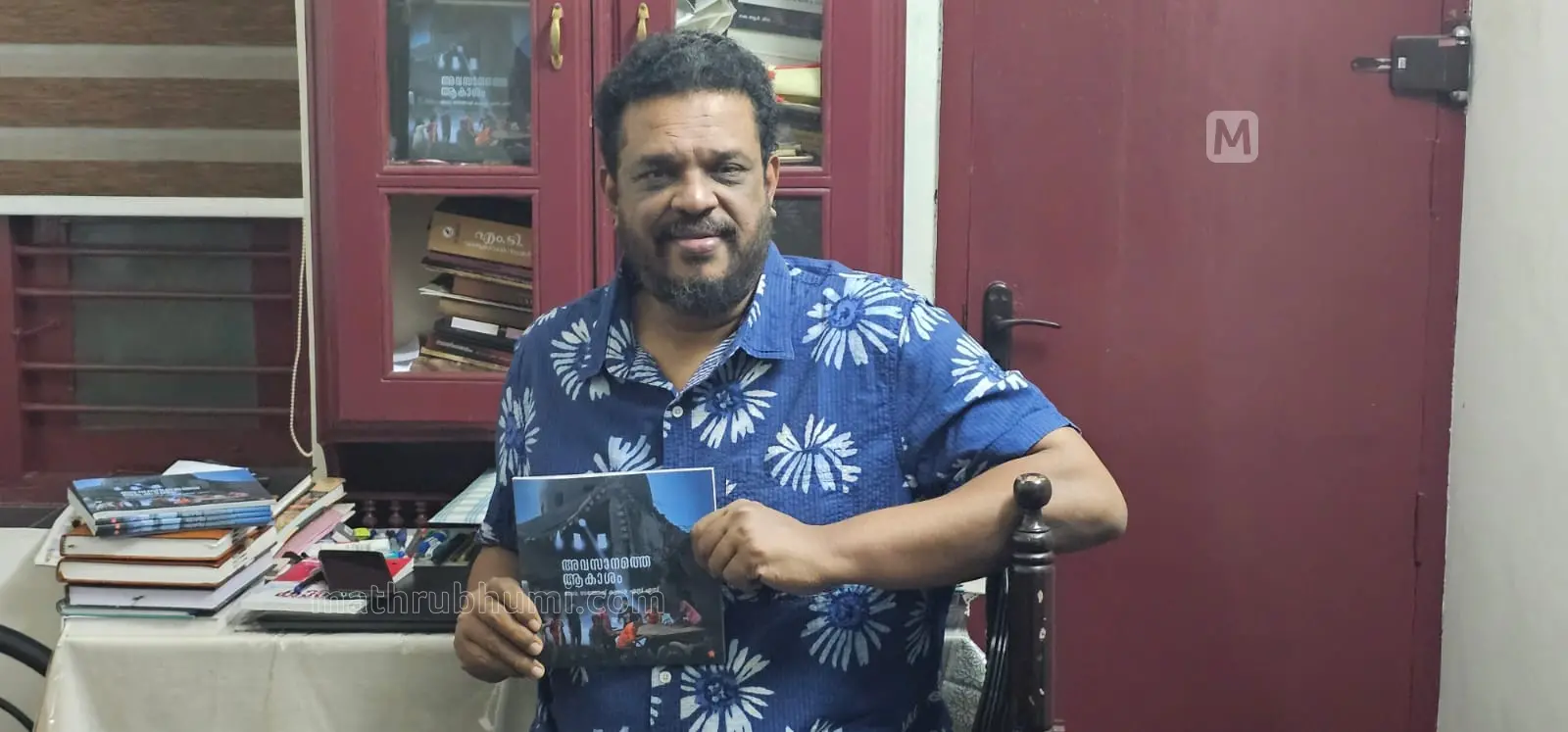
Dr Kumar calls Gaza the world's largest concentration camp. An exhibition of pictures he shot on his mobile phone bears witness to the unfolding human tragedy in Gaza. Chinta Publishers has brought these images together in a book titled The Last Sky, borrowing from the Egyptian-Palestinian poet Mahmoud Darwish’s haunting poem, “Where should the birds fly after the last sky?” Writer Arundhati Roy wrote after seeing Kumar’s photographs: “... one of the most effective things I’ve seen because it comes with a literally day-to-day diary-like commentary about what this war actually means. It’s not just about death. It is not just about bombing, but exactly what happens to its population, to its history, to its memory”. This is Dr Kumar’s second book after his “Gun and Syringe” (2024), a collection of notes on his service in other disaster zones.
A former head of Emergency Medicine at Thiruvananthapuram’s Government Medical College, Kumar had led the Kerala medical team that set up the state’s first COVID-speciality hospital in Kasargod when the pandemic struck in 2020. Subsequently, he set up a similar hospital in Maharashtra on the request of the state government there.
Ironically, instead of honouring Kumar for such rare work, he has often been punished thanks to the ways of our petty political and bureaucratic mandarins. In a tell-tale illustration of this absurdity, Kumar was punitively relieved of his duties as Deputy Superintendent of the Medical College in 2022, reportedly for being absent from the hospital when the then Health Minister made a surprise visit in October 2021. The irony was that Kumar’s absences were often due to his life-saving missions abroad, for which he had taken leave without pay from government service. The cumbersome bureaucratic rules governing such leave made it exceedingly difficult for a government doctor to combine public service at home with humanitarian work in disaster zones abroad.
Kumar came to know about Doctors Without Borders in 1991 while he was a student member of the medical team that served the victims of the devastating Latur earthquake in Maharashtra in 1991. Kumar’s commitment to voluntary service among disaster victims began while he was an MBBS student at the Medical College in Thiruvananthapuram. As secretary of the National Service Scheme’s college unit, Kumar was in the medical team that served the rescue and rehabilitation of the victims of a flood in Karimadom colony and a landslide in Amboori in Thiruvananthapuram.
What makes Gaza unprecedented in terms of human brutality? Genocides, massacres, killing innocent people, including children, by bombs, biological or chemical weapons or deliberate starvation are not new to human history. Recent times also have witnessed such atrocities in various countries. “Yet, all of them were committed under cover or behind walls. But what Israel does in Gaza happens right in front of the world and in full glare of the global media, in brazen defiance of every international convention and repeated restraining orders of the UN. Yet, there is no concerted effort to stop it”.
The unimaginable barbarity of Hitler's Nazi concentration camps, such as Auschwitz, demonstrated in the last century how cruel humans could be towards their fellow beings even in an age of modernity and democracy. The aftermath of the Second World War saw a collective determination by humanity to ensure that such horrors would never recur. International laws and institutions like the UN were created, which all governments should abide by to prevent such barbarities in future. The UN and major countries often used force, sanctions, or diplomatic intervention to confront atrocities and human rights violations wherever they were committed anywhere in the world, from the aftermath of Nazi Germany to Rwanda or Serbia in recent times. But now the UN has been rendered powerless primarily by the US, and the governments of other countries either watch in silence or even back Israel in various ways. “That makes Gaza unprecedented in modern history”, says Kumar.
Gaza also points an accusing finger at the present world with a question: How could all of us remain silent when such atrocities are being committed continuously, especially on the children by Israel with the connivance of the USA? Unfortunately, India, which was once in the global forefront in condemning wars and invasions and upholding the cause of peace, has now remained mute, not to upset the USA. Worse, it also has been one of Israel’s top arms suppliers despite the UN’s Human Rights Panel passing a resolution in April 2024 asking countries not to export weapons to Israel. Recently, Tariq Ali, the prominent activist and writer, said that the Indian Opposition have also remained mere onlookers. India was the only major democracy which did not hold significant protests against the assault on Gaza. He wondered why even the Left parties have failed to organise such a protest and asked if it was also afraid of being accused of appeasing Muslims by the anti-Muslim Modi government.
Kerala at least can claim a better record. Thiruvananthapuram witnessed a major protest against the war on Gaza a few months ago. Perhaps, in that context, Santhosh Kumar’s services, too, could be considered more than the work of a courageous doctor. His is a symbolic act of redemption on behalf of all of us for not doing good enough.