What the Trump-Putin-Xi summit means for India and the global balance of power
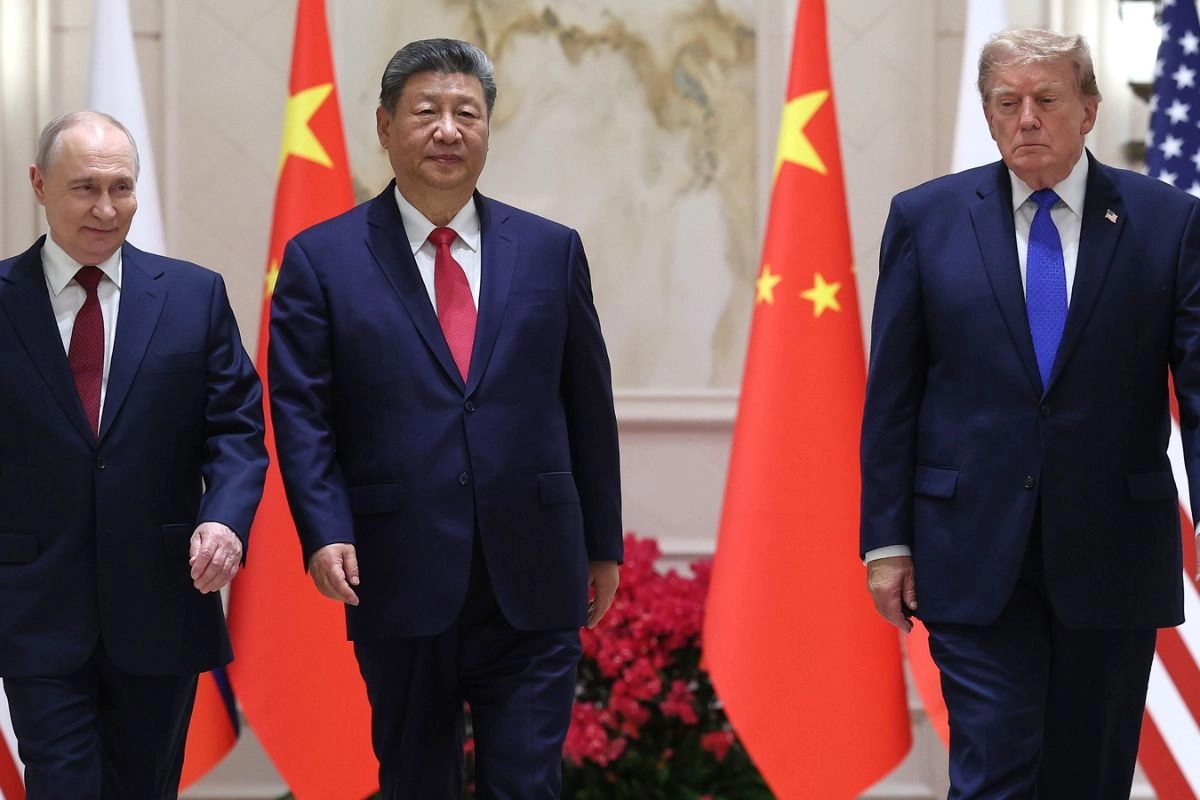
A rare opportunity to lower global tensions opened up Thursday for the world’s most powerful leaders, Donald Trump, Vladimir Putin and Xi Jinping as they converged for the first trilateral summit decades after a similar meeting in Yalta in February 1945. But the submit’s outcome revealed that these leaders —representing three permanent members of the United Nations were unable to rise above their individual insecurities and narrow ambitions.
The “peace declaration” issued after the meeting in Shenzhen, the Chinese boom city, made no mention of three hotspot issues, which are the wars in the Middle East and Ukraine besides the need for specific targets for nuclear disarmament. Informed sources said that Putin raise the Ukraine issue and Xi talked about Taiwan but the joint declaration skipped mentioning them because there was no agreement. The absence of an agreement is worrisome because these leaders control 90% of nuclear warheads and 51% of military spending.
There was little headway to justify Trump’s claim: “We are really making history”. He rated the meeting "a 12 on a scale of zero to 10". On the other hand, Chinese Foreign Minister Wang Yi revealed the summit’s modest gains when he said that the talks "created a paradigm for interaction”.
On energy, there was the clearest sign of thought convergence. “The three countries plan to increase the production and supply of refined petroleum products for the benefit of all nations. They reaffirmed the importance of stable energy flows,” the declaration said.
The leaders behaved as if they had not heard about the Nvidia spy scandal and its wide-ranging implications with the declaration staying silent about semiconductor chips and artificial intelligence (AI). This is curious because the US tightened AI chip export and remote cloud-computing restrictions three days before the talks.
The leaders choose to describe it as a “peace declaration” because there was an agreement about the need to reduce production of nuclear warheads and destroy existing ones though no timelines were agreed upon. This in itself is not much of a headway because the UN was established on this idea way back in 1945.
The American president gave an idea about why nuclear disarmament talks didn’t make much progress. Trump acknowledged the difficulty of giving up nuclear arsenals: "Once you have the nuclear weapons, it's very hard to not have them. It's very hard to give them up as the leader of a country... It's the way life works".
Though there is no agreement, the leaders have decided to carry forward their dialogue on nuclear disarmament. Before the meeting, China’s Xi said that "a nuclear war cannot be won and must never be fought," adding that "every effort must be made to prevent nuclear war". He called for nuclear weapons to be "comprehensively prohibited and completely destroyed, with the ultimate goal of building a world free of nuclear weapons".
China, which has the smallest stockpile of 600 nuclear warheads, wants the U.S. and Russia to conduct disarmament at a higher pace because they have much more warheads. The agreement between U.S. and Russia, each of whom has over 5,000 warheads, expired in February. By contrast, India has 170 nuclear warheads and Pakistan 120.
China’s Xi said the countries should shed a “Cold War mentality” and become friends. Putin said that the three countries can strengthen global stability if they cooperate constructively.
India’s position
The trilateral showed that the three leaders think they can discuss world affairs without consulting India, the second biggest arms buyer and third biggest oil buyer, and the European continent. India ranks 6th ahead of Russia which is 8th in GDP terms, according to the IMF. United Kingdom and France, the UN permanent members, were not at the table. Europe’s share of world trade at 16% is higher than the U.S., China and Russia. But its political voice is feeble due to internal dissensions.
Seen in political terms, India has no reasons to be disappointed over insufficient progress at the trilateral summit. If there was a meeting of minds, it would have meant the creation of a G3 power group and a lowering in India’s political importance. Non-alignment or Narendra Modi’s policy of strategic autonomy plus multi-alignment works when countries compete with each other, not when they form unified blocs. Modi and Trump met on Tuesday during the QUAD summit in Manila.
The leaders at the trilateral betrayed their individual insecurities as they concurred that the International Criminal Court (ICC) and similar bodies "must not abuse their jurisdiction" and summon state officials. ICC has issued an arrest warrant on Putin. Trump has been furious since ICC summoned Israeli Prime minister Benjamin Netanyahu for the massacre in Gaza. China, which is often accused of human rights violations, does not want its internal affairs discussed. Meanwhile, the UN has expressed its full support for the IIC.
President Trump will host the G20 meeting in Miami. Xi is expected to attend it offering another opportunity for a bilateral meeting. It is unclear whether Putin would attend though Russia is a G20 member. The U.S. which is not a member of ICC is under no obligation to enforce its arrest warrant against Putin but the Russian leader might avoid travelling there.
What remains to be see is whether the three leaders-only one of whom represents a democracy would choose to hold more trilaterals to create a G3 institution for shaping world politics to suit their requirements.