The plot thickens as the evidence gets Trumped
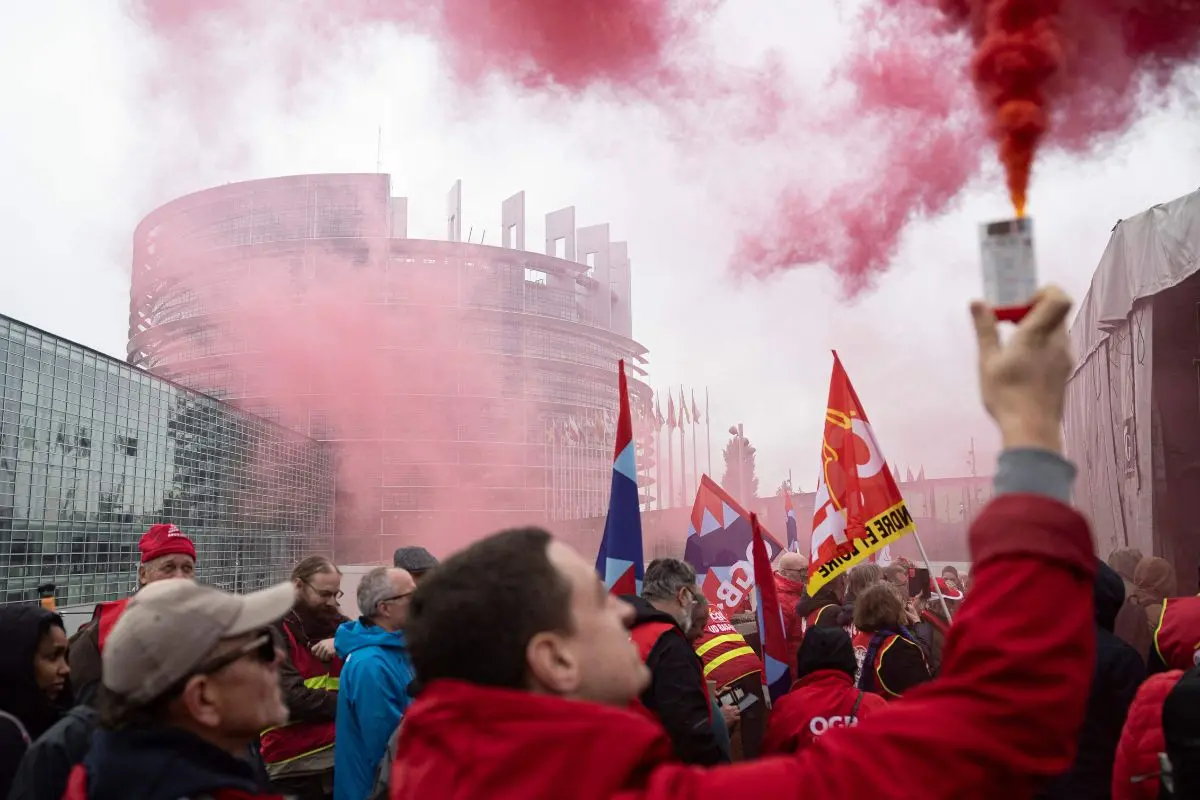
There is a remarkably economical way to manufacture a political conspiracy. Take a photograph, preferably one containing a flag, a bearded man, a religious slogan or somebody behaving badly. Add a suitably alarming caption, remove the inconvenient context and allow the human appetite for outrage to do the rest. Within hours, an individual becomes a community, a crowd becomes a movement, and an event becomes proof of a conspiracy that existed only in the imagination of the person who supplied the caption. The latest specimen comes from France, where Donald Trump has discovered that the country's student protests are not really about schools at all, but about Islam attempting to take over a once great nation. This is an impressive feat of clairvoyance, especially from a man not known to have spent much time examining French classrooms.
On 6 October, Trump declared that the unrest was the result of uncontrolled mass migration and that the school grievances were merely a cover for an Islamic project. He supplied no evidence for this remarkable diagnosis. Presidential authority now seems to include the ability to identify the secret motives of hundreds of thousands of people without the tedious preliminary business of investigating them.
The facts, inconveniently, tell a rather different story. The protests began with French school students complaining about teacher shortages, overcrowded classrooms, deteriorating buildings and inadequate educational resources. Their grievances were not conjured out of thin air by some international conspiracy. Reporting by the BBC, AFP and Reuters documented the education crisis and the spread of demonstrations across the country. The protests subsequently drew in trade unions, workers and others angered by rising living costs and government spending proposals. There were clashes with police, looting and arson, and there are legitimate questions to be asked about both the violence and the police response. None of this, however, establishes that the movement was an Islamist uprising or an attempt to impose Islamic law on France.
AFP's reporting on Trump's allegation noted that no link had been established between the student movement and religious or identity-based demands. That is a fairly important omission in a story whose principal claim is that the real issue has nothing to do with the issue the protesters themselves have been describing. One might have expected the discoverer of this hidden Islamic masterplan to produce at least a scrap of evidence; perhaps a document or an organised group issuing demands, or a credible investigation. Something beyond the fact that a photograph contains people whose presence can be made to look alarming if the caption is sufficiently inventive. But evidence is the most inconvenient guest at any political rally because it has a habit of asking questions, and questions are not particularly welcome when the conclusion has already been decided.
It is important to be clear about the distinction. If an Islamist organisation was involved in particular incidents, identify it and produce the evidence, or if an individual carried a religiously worded placard, establish what it said and what the individual meant by it. Or if somebody committed a crime, investigate and prosecute that person. These are very reasonable demands, and none requires us to pretend that Islamist extremism does not exist. They do, however, require that we distinguish between evidence of individual conduct and allegations about an entire movement. This distinction becomes particularly useful when we cross the Atlantic and revisit 6 January 2021, when supporters of Donald Trump stormed the United States Capitol to disrupt the certification of Joe Biden's election victory. Among the flags visible during the events was the Indian Tricolour. The man The Indian Express identified as carrying it was Vincent Xavier Palanthigal, an Indian American and member of the Virginia Republican Party's State Central Committee.
Now imagine the intellectual gymnastics required to conclude from this photograph that India had organised the attack on the Capitol, or that Indians as a community were conspiring to overthrow American democracy. The proposition is preposterous, and its absurdity does not diminish because the photograph is genuine. Palanthigal said he had joined the march and claimed he knew little about the destruction inside the Capitol. His account does not settle every question about his conduct, but the presence of an Indian flag certainly does not establish the responsibility of India or Indians collectively.
The same elementary rule of reasoning applies in France. A Palestinian flag does not establish an Islamist agenda, nor does a religious slogan reveal the secret intentions of an entire crowd. The presence of an individual with radical beliefs does not transform every person in the vicinity into a member of the same ideological organisation. If the rules of evidence are to mean anything, they must survive contact with people whose politics we dislike. There is, of course, a political advantage in refusing to observe these distinctions. A dispute about teacher shortages demands an uncomfortable conversation about public expenditure, recruitment, educational inequality and the state's obligations to its citizens. A dispute about immigration and Islam offers something much more immediately marketable as it supplies an enemy, a civilisational drama and the com forting prospect that every social problem can be explained by the presence of the wrong people. The classroom is complicated, but the imagined invasion is wonderfully simple.
This is why the violence accompanying the protests deserves scrutiny without being allowed to swallow the entire story. Looting is not an educational policy, arson is not a substitute for a teacher, and the destruction of a shop does not become morally acceptable because its perpetrator is economically disadvantaged. Yet neither does a burning building establish that the original grievances were fraudulent. A movement involving hundreds of thousands of people cannot be understood solely by examining the worst behaviour of a small minority, just as a country cannot be judged by the most disreputable person photographed carrying its flag.
The trick is to substitute association for proof, then insist that anybody asking for proof must be an apologist for the alleged offenders. It is a familiar manoeuvre in political propaganda, and it works because indignation is considerably less demanding than investigation. Once people have been persuaded to fear a community, every photograph becomes confirmation, every unexplained detail becomes suspicious, and every request for evidence becomes an act of disloyalty. We should resist this not because France is beyond criticism or because immigration is beyond debate or religious extremism should be ignored.
We should resist it because the alternative is to surrender the distinction between knowing something and merely suspecting it, and that distinction is the foundation of responsible journalism, rational argument and, for that matter, any halfway respectable legal system. A photograph can establish that somebody was present and it may well establish what that person was carrying, where they stood and what they appeared to be doing. It cannot, without additional evidence, establish their motives, the purpose of an entire movement or the guilt of a community. These are not complicated propositions, but they are simply propositions that become inconvenient when the objective is to inflame rather than inform.
Trump is entitled to his opinions about France and his admirers are entitled to agree with him, but neither is entitled to transform an unsupported allegation into an established fact by attaching it to a genuine video and forwarding it with sufficient indignation. The next time a sensational clip appears in your WhatsApp group, ask what it actually proves. Ask who filmed it, when it was filmed, what happened before and after the camera started rolling, and whether independent reporting supports the interpretation being offered.
Above all, ask whether the same reasoning would persuade you if the political identities were reversed. If it would not, you probably have not discovered the truth. You have discovered a prejudice wearing the costume of an investigation. Verify before you forward. A photograph may be worth a thousand words, but a thousand words of insinuation are still not evidence.
(The author is a National Award winner for Best Narration and an independent political analyst. Views expressed are personal.)