Strong women in Malayalam cinema by male directors
The patriarchal mindset of men and even women, has proved to be one of the main obstacles in the representation of women in films mainly directed by men. This is not to say that all women directors are biased in the representation of women in their films. But by and large, women directors are like a drop in the ocean of films right across the country and this includes Malayalam films, reportedly quite progressive and sometimes, even revolutionary in their representation of women in their films.
This writer will take a closer look at three recent Malayalam films, a few of them by debutant directors to try and examine the way in which they have dealt with the major women characters in their films without resorting to candle-light marches, flag-held demonstrations or even extra-long lectures on how women can and should be represented in films. No item songs, no villains, no romance even.
Aattam (The Play) released in 2023, is placed in Kerala in contemporary times. Shot mainly indoors within the precincts of a house used for rehearsals by a theatre group, it lacks the visual beauty one is used to see in most films shot outdoors in Kerala. It revolves around the rehearsals, the performance of what appears like a costume drama which has twelve actors, all male except one female whose camaraderie with her male colleagues is quite normal and friendly.
The film does not focus on any particular play except towards the end but rather, on what ensues among the members of the group including the manager Madan (Madan Babu K) and a relatively new entrant, a noted film actor Hari, that pushes up the popularity of the play among the audience. Hari (Kalabhavan Shajohn), a film actor, throws his starry weight about. Hari has also angered Vinay (Vinay Forrt) because he has replaced Vinay as the hero. Vinay, professionally a chef is on the way to divorcing his wife and is having a torrid affair with Anjali (Zarin Shihab) the sole female in the group. He keeps promising marriage to her which appears doubtful.
The members of the theatre group are ordinary men living less-than-ordinary lives. One is an electrician, another a plumber, a third a cook and so on which points out that they are not doing theatre so much for money as for the passion. The theatre group is small in budget and also in its spread among theatre fans. One night, after a performance, the group is invited to party by a foreign couple which owns a bungalow in Kochi with food and drinks on the house. Anjali gets drunk along with the men. Sometime later, she goes to sleep. When Vinay follows her, he learns that in her sleep, someone groped her. Vinay rushes in to report this to Madan. But she has no clue who it was as she was drunk and sleeping in the dark.
The question is not about a girl being groped. It is about how male colleagues are passive participants in the act because they are ready to pin her accusation with suspicion and Anjali feels groped again and again for being asked repeatedly about how and whether she saw the accused or not.
When she walks out of the group angry, hurt and doubly humiliated, she does not care about the identity of her groper because she labels all the men in her group as biased against women, and specially Anjali, their talented colleague who is the only female actor the group cannot imagine a performance without.
The best point of the film is that we never get to know who groped her. Does she know it herself? Isn’t the fact that she was groped by one of the men in the group enough to drive home the politics of power imbalance that sustains in our society between man and woman? Aattam is the strongest feminist statement in a film directed by a man in a long time and this is Anand Ekarshi’s directorial debut. Ekarshi keeps it very understated, spilling over with quite mundane dialogue and keeping away from either sentiment or sensation. It takes time for the viewer to grasp what the film exactly wants to say but when we grasp it, we are shocked by the brutality of the experience and the way in which this is portrayed, specially the twist in the climax.
Aattam won the 2023 Grand Jury Award at the Indian Film Festival of Los Angeles. It was also chosen as the opening feature film at the 54th International Film Festival of India held at Goa.
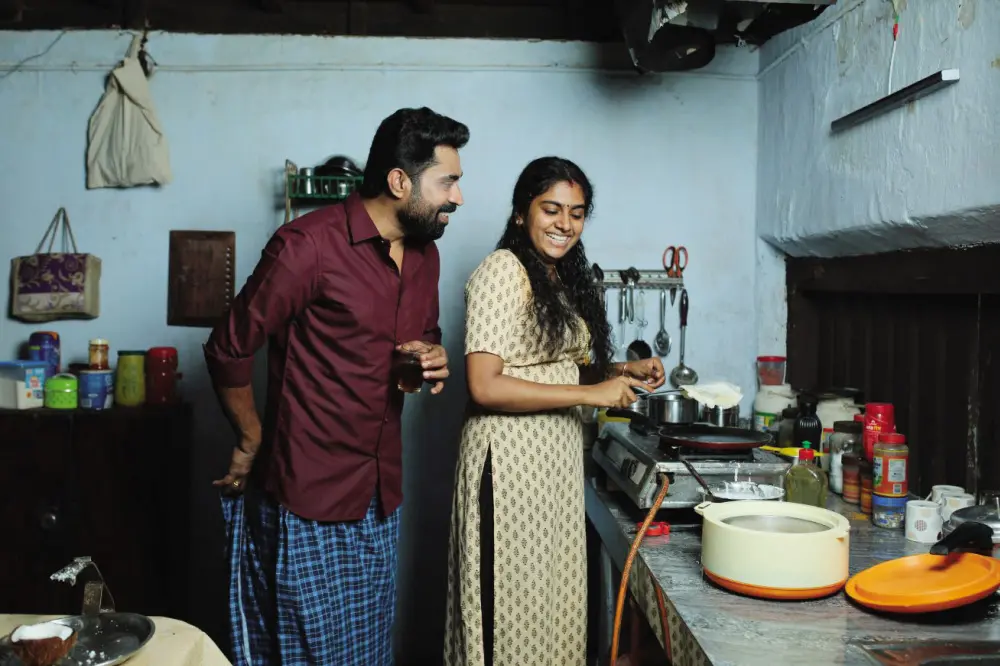
The Great Indian Kitchen (2021) Jeo Baby has already carved a name for himself for bringing out the power in his women characters in most of his films but this is possibly the first in Indian cinema to make the “kitchen” the protagonist of the film. The newly-wed bride who steps into her husband’s family is directed straight into the kitchen. There is no escape until she does it herself, physically.
The film points out that “kitchen” is actually a metaphor for the larger prison in disguise for the free slave otherwise called the “bahu” for who there is no escape. Sweeping every corner of the house including the courtyard, brooming, washing clothes, sorry, no washing machine but on a big stone, washing vessels, grinding spices, fermenting cereals, making tea and cleaning the table disgustingly dirtied by father and son who chew their drumsticks in the sambar and throw waste on the table.
The wife’s sex life does not exist and like any paid sex worker, for her, it is “wham, bam, thank you ma’am” till she complains about how painful sex is for her without foreplay. The husband sarcastically comments on her use of the word ‘foreplay’ and cruelly says that some feelings for the partner are mandatory for foreplay! Really? Is she not his wife?
The director and the camera go on focussing continuously on the household chores the young woman is forever engaged in, without rest, without love, without friends, without even sex - sweeping, brooming, cleaning, washing, grinding, cooking, roasting, serving, dusting, in fact, doing everything except living a normal, reasonably happy life like any normal, married girl.
The repetition of these scenes highlights the reducing of a young and happy girl to an unpaid servant in her husband’s home with her silence first suggesting her compliance with the system and then as an expression of her growing anger that finally bursts out in an act of rebellion, also silent. The repeat shots may appear a bit boring but on hindsight, one realises that the treatment has been deliberately dragged to drive home the point of the meaningless futility of existence of women placed in similar situations.
This is no drunk or alcoholic husband beating up his wife. This is no father-in-law torturing the young woman for more dowry. This is no husband having a woman on the side or suspecting the wife of an adulterous affair. This is a supposedly normal family that leads a supposedly normal life at the cost of sacrificing the women in the family reduced to mechanized robots. And this perception has come from a man! The film won the Best Film Award at the Kerala State Film Awards in 2021.
Ulozhukku (Undercurrents) This 2024 film marks the directorial debut of Christo Tomy. An alumnus of the SRFTI Kolkata, Tomy is a veteran winner of National Awards for his short films. He won it again for his directorial command in Ulozhukku which also bagged the National Award for the Best Malayalam Film last year, besides many more awards and nominations at other festivals.
In a long, long time, cinema lovers may not have come across such a touching connection one, between man and Nature and two, between two women bonded through an unfortunate marriage forced to live together till they find common ground. Of the two women, Leelamma (Urvashi) is Anju (Parvathy)’s mother-in-law stranded on their small home which has turned into a virtual island when the Kerala monsoon floods everything around, jamming all preparations for the burial of Leelamma’s dead son Thomas Kutty who was Anju’s husband. It is impossible for the viewer to take his eyes away from the screen even to blink.
The long and patient wait for the last rites of the young man who is the son of Leelamma and the husband of Anju metamorphoses into a coping mechanism for the two women distant in terms of age, education, status, experience and belief which unwittingly and subconsciously becomes a vehicle of transforming the relationship from betrayal to good faith. Anju learns that Leelamma had hidden the fact of her son’s fatal illness during marriage and feels betrayed when she learns the truth. Leelamma feels betrayed when she learns that Anju has not only revived her relationship with the Hindu restaurant worker Rajeev and is also carrying his baby. Each one knows about the other one’s betrayal and Anju is eagerly and desperately waiting for the rituals to get over and embark on a new life with Rajeev. Leelamma is bitter to begin with but adjusts with the reality over time. What happens in the climax is a very humane one. The rains have dissipated but Anju, instead of joining the waiting Rakesh, gets on the boat with Leelamma setting sail for a new life – together.
None of the male directors of these films used any skin show, or, item numbers, or any intention to show off their characters as “objects” of the cinematic apparatus which includes cinematography, the script, editing, direction, acting et al. There is absolutely no sloganeering, no political activism, no feminist flag-hoisting. Only statements of life caught in adverse circumstances and how these circumstances are overcome or not overcome. Very much like Life itself. The only factor being that they are all women.