Nuisance vs Necessity: Why major powers keep Pakistan close
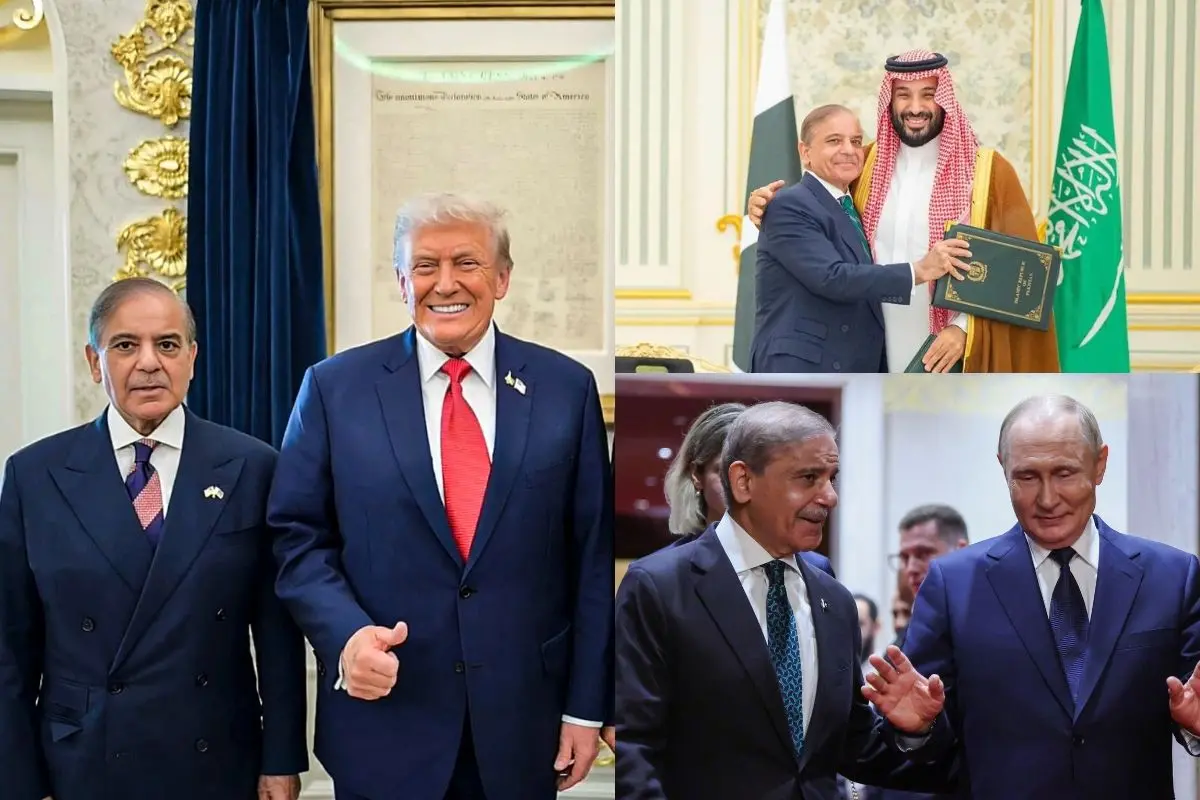
India needs to stop assuming that Pakistan has become irrelevant on the world stage. For years, we have believed our growing economic and military strength had sidelined our western neighbour. But recent developments tell a different story. Donald Trump is re-engaging with Islamabad. Russia is building closer ties. China continues its unwavering support. Clearly, Pakistan still matters in global politics, and we must understand why.
The answer lies in three factors that major powers cannot ignore: Pakistan's strategic location, its ability to influence regional conflicts, and its formidable military strength.
Pakistan sits at a crucial crossroads, bordering Afghanistan, Iran, China and India, whilst lying close to Gulf nations like Saudi Arabia. This makes it a natural bridge between South Asia, Central Asia and the Middle East.
Through Afghanistan, it connects to the resource-rich Central Asian republics -- Kazakhstan, Uzbekistan, Turkmenistan, Tajikistan and Kyrgyzstan. Its naval and air bases offer powerful nations the ability to project force across a vast region. Foreign militaries can use Pakistani territory for operations in Afghanistan or Iran. Though it may sound far-fetched today, China could potentially use Pakistan as a launchpad against India in a future conflict.
The second reason for Pakistan's continued importance is more uncomfortable to acknowledge. It thrives on its capacity to create instability. Indian officials rightly call it a state sponsor of terrorism. Yet paradoxically, this very characteristic keeps the world engaged with Islamabad.
China, Russia and the United States all worry about Pakistan's links with extremist groups and its tendency to use such proxies to exert pressure. Here's what we must grasp: constant criticism of Pakistan often strengthens rather than weakens its position.
Pakistani leaders aren't embarrassed by their country's troublesome image. Instead, they weaponise it, making the world fear potential chaos unless Pakistan receives continued attention and support.
Many Indians dismiss Pakistan as weak and failing. This is a dangerous miscalculation. Pakistan possesses five enduring strengths that ensure its relevance: a powerful military, a massive population, Islamic identity, an influential global diaspora, and proven alliance-building capabilities.
Pakistan's armed forces number around five lakh soldiers, ranking among the world's largest armies. More critically, it's a nuclear power with approximately 200 warheads -- comparable to India's arsenal, with some reports suggesting it may even have more.
Our recent border confrontations have demonstrated that Pakistan's forces are skilled, well-trained and battle-ready. Equipped with Chinese weapons and real-time battlefield intelligence, its military commands global respect. This strength serves multiple purposes.
Foreign powers have historically used Pakistan's army for their own strategic objectives. The ongoing Pakistan-Afghanistan clashes aren't merely about the Durand Line or terror groups -- it's entirely possible that external powers are using Pakistan to pressure the Afghan Taliban.
Pakistan's influence extends beyond military might. With a population of about 26 crore, it ranks as the world's fifth-largest country. By 2050, demographers predict it could reach 34-38 crore, making it the third largest after India and China.
Like India, it has a predominantly young population that represents both a workforce and a consumer market. If Pakistan manages to stabilise its economy, it could become a significant destination for global trade and investment. No major power wants to forfeit access to such potential.
The Islamic dimension adds another layer to Pakistan's strategic value. As the world's second-largest Muslim nation, Pakistan wields considerable influence despite its relative poverty. For many Muslims worldwide, Pakistan's military and nuclear weapons -- often called the "Islamic bomb" -- represent symbols of pride and protection. Pakistan's diplomats are sophisticated, maintaining active relationships not just with the West and China but across the Muslim world.
Within the Organisation of Islamic Cooperation, Pakistan holds significant sway. Powers seeking stability in Islamic regions -- China, Russia and the United States -- cannot afford to ignore Pakistan's diplomatic weight.
Pakistan's overseas community also matters. Between 1995 and 2020, about 61 lakh Pakistanis emigrated, making Pakistan the world's sixth-largest source of emigrants. Today, approximately one to 1.1 crore Pakistanis live abroad -- roughly 30 per cent the size of India's diaspora -- concentrated mainly in Saudi Arabia, other Gulf states and English-speaking countries. These communities exert political and economic influence that foreign governments take seriously.
Finally, Pakistan's alliance-building capacity enhances its importance. In the 1950s and 1960s, it was a US ally through SEATO and CENTO. Since 1963, it has maintained a close partnership with China. In the 1980s, it worked with both China and America against the Soviet Union by supporting Afghan Mujahideen.
After 9/11, Pakistan became crucial to US operations in Afghanistan. For decades, it has maintained military ties with Saudi Arabia, even stationing troops there. Recently, it signed a new alliance pact with Riyadh, reportedly including nuclear protection guarantees. This readiness to form strategic partnerships continues making Pakistan attractive to major powers.
That said, India today is strong enough to deter Pakistan militarily. Our armed forces are larger, better equipped and more technologically advanced. Our economy is nearly ten times bigger. Our diplomatic reach extends far wider. Pakistan knows that any major misadventure against India would be catastrophic for Islamabad. But deterrence isn't the same as irrelevance.
Pakistan's global importance stems not from its ability to defeat India but from its strategic location, its capacity for disruption, and its value to other major powers pursuing their own interests.
However uncomfortable this reality may be, Pakistan remains a significant player in global strategy. Major powers will continue engaging with it whilst simultaneously maintaining strong ties with India. This is the reality. India's foreign policy must remain calm, strategic and realistic when dealing with Pakistan's global role.
Anger or arrogance won't help -- only clear thinking and steady diplomacy will secure our interests in a complex world.
The author is a defence, aerospace & geopolitical analyst. Views expressed are personal