OPINIONThis protest is only the entrance exam
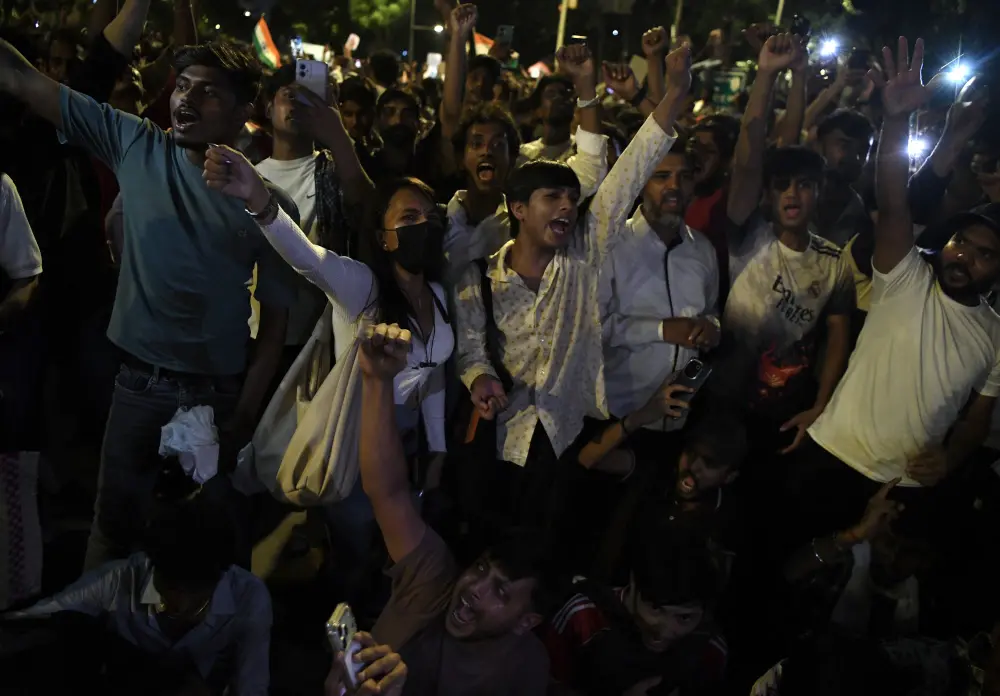
A group of teenage girls at Delhi's Jantar Mantar, tears streaming down their faces, stand before a line of riot police singing the national anthem as though it is the only weapon they have left.
Elsewhere, medical students arrive carrying supplies to set up makeshift field hospitals. They bandage strangers on pavements.
Hundreds of kilometres away, people who cannot march themselves quietly order food and drinking water for protesters they will never meet.
Richard Attenborough spent millions of dollars trying to recreate moments like these for his Oscar winning movie, Gandhi. Delhi produced them for free, in real time, because they were never cinema. They are what happens when a state confronts its own children with batons.
Perhaps that is why these images from the protest organised by the Cockroach Janta Party have travelled so far and so fast. They are no longer just images from a single demonstration in Delhi. They have become a mirror in which millions of Indians see their own frustrations reflected.
They are reminders of what citizenship looks like when stripped of slogans, television debates and political spin.
They reach people because everyone sees someone they know in those faces – a daughter, a son, a younger sibling, perhaps even the idealistic version of themselves they left behind years ago.
Those girls singing the national anthem are not simply protesters. They are children asking their country whether the promises made to them were ever real. The uncomfortable truth is that the question is really for the rest of us.
Watching those students, I couldn't escape another uncomfortable thought. Every one of my generation should feel guilty. We are asking our children to fight battles we should never have left for them.
We allowed institutions to weaken, corruption become routine and cynicism become a way of life. We complained, we laughed, we shrugged and moved on. They are the ones standing in the rain, facing lathis and tear gas, trying to reclaim what we quietly surrendered.
The emotion gripping the country today is genuine. But history tells us it is also the easiest part.
Across Asia, youth movements have repeatedly captured the imagination of entire nations. Ordinary people have rallied around students because they instinctively recognise courage when they see it. Yet what follows is often painfully predictable.
Power rarely yields because it has been morally defeated. It adapts.
In every place where such protest happened, the tactics used by those in power fall into a very distinct pattern, only the degree of intensity varies. Brute force. Non-state actors deployed sometimes in full police gear to unleash violence and create chaos.
Then protest leaders branded as anti-nationals, traitors, puppets of foreign governments, funded by the usual convenient bogeyman, George Soros. Young women on the protest lines accused of being loose and immoral, cases slapped against those who come along to support.
The movement is infiltrated, divided, exhausted. Public attention drifts elsewhere. Governments simply wait.
Hong Kong remains the cautionary tale. In 2019, millions marched. Entire neighbourhoods protected students they had never met. The world watched with admiration. Beijing then tightened its grip with a sweeping National Security Law. Many of the movement's leaders remain behind bars years later. The city survived. The freedoms did not.
Elsewhere, the story has ended differently but with equally sobering lessons. In Thailand, the youth vote won elections. But the machinery that was never on the ballot – military, monarchy, judiciary – simply disqualified the outcome through the courts. No tear gas required.
Similar protests in Indonesia were short-lived, but the anger continues to rumble like a volcano. These are symptoms of democratic systems that once promised to put “people first” but are breaking down.
In Nepal, Sri Lanka and Bangladesh, governments fell, but replacing governments proved far easier than repairing institutions.
That is the danger of believing the hardest part is filling the streets. It isn’t. The hardest part begins after the cameras leave.
It begins when outrage cools, hashtags disappear and society asks the protesters to “move on.” It begins when institutions that have spent decades protecting themselves quietly begin protecting themselves again.
It begins when people who stood shoulder to shoulder discover they disagree on what victory should look like.
Delhi's students should celebrate every victory they earn. A re-examination. A minister forced to answer questions. An official suspended. Every one of those matters.
But they should never mistake them for the destination.
This protest – however righteous, however overdue – is only the entrance exam. Even a perfect score merely gets you into the system, not past it.
The corruption they are marching against does not end with a leaked examination paper. It lives in the colleges beyond it, the recruitment boards beyond those, the ministries beyond them – sustained by a political culture that has survived governments, ideologies and elections alike.
Win this battle. Win it completely. But history's cruellest lesson is this: bringing thousands onto the streets is difficult; transforming the institutions they are fighting is infinitely harder.