Main Wapas Aaunga turns partition into a timeless love story
“Partition” has become a two-edged sword for filmmakers who often reveal an interest in holding up a mirror to the Partition of India in general and Bengal and the Punjab in particular presented through their cinematic lenses and personal perspectives. Professor Vazira Zamindar calls partition the “wound within, the mother of many millions of individual identity crises that seem never to go away."
Hindi cinema, much before it acquired the “Westernised” term “Bollywood” has made meaningful films set against the Partition of India. But many films are entirely mainstream filled with music, dance, romance and action and violence of which many such as Gadar – Ek Prem Katha, Border, Veer-Zaara (2004) and now, Main Wapas Aaunga directed by Imtiaz Ali. For example, there is no coyness in Gadar: Ek Prem Katha (2001), Anil Sharma’s chest-thumping and eardrum-shattering film about the romance between a Sikh man and a Muslim woman during the tumult of 1947. Zaara of Veer Zaara comes to India to immerse the ashes of her Sikh nanny. She falls in love with a Hindu pilot, who later crosses the border to find her. It is said that every Hindi movie about children or siblings separated from their family members is actually about Partition. Could the earthquake that splits the family of Kedarnath in Yash Chopra’s Waqt (1965) actually be an indirect reference to Partition?
But there are also films that blend commercial ingredients with tracts from the Partition in an aesthetically significant manner and Main Wapas Aaunga is a classic example of this blend of a solid storyline, aesthetic excellence and commercial prospects.
Garm Hawa however, is not a mainstream film. It was the first film to deal with the human consequences resulting from the 1947 partition of India. This action, ordered by British Lord Mountbatten, split India into religious coalitions, with India remaining Hindi and the new country of Pakistan serving as a refuge for Muslims. Is ‘refuge’ the right word for Muslims who did not wish to leave? Would they be accepted socially and economically by the original residents of the newly formed Pakistan?
Dr. Ira Bhaskar, ex-associate professor of arts and aesthetics at the Jawaharlal Nehru University (JNU), delivered a speech on Partition films on November 1, 2006, on the basis of her in-depth research on the subject said that the first film on partition after Independence was 'Dharamputra' in 1961. “Yash Chopra's 'Dharamputra' addressed the communal crisis. The film looks at the other side of the picture - the role of Hindu fundamentalists in partition. It was a solid critique of Hindu fundamentalism and that's why it was very radical for its time,” she said.
By conservative estimates, anywhere upward of half a million lost their lives due to the fateful event of 1947 when someone decided to draw the Radcliffe line. Over 70,000 women were raped and about 12 million people fled their homes. Nearly 500,000 deaths must have taken place, a figure that Ian Stevens points out is equal to the number of casualties sustained by the entire British army during the six years of WW II (107). Many of these casualties took place as part of a mass exodus in which Hindus frantically made their way to India and Muslims to Pakistan. It is difficult to tell where entertainment ends and the political element begin and vice versa. Does a director use entertainment to cushion his political statement? Or does a filmmaker make a pretentious attempt to spout something covertly political to add one more dimension to his entertainment factor?
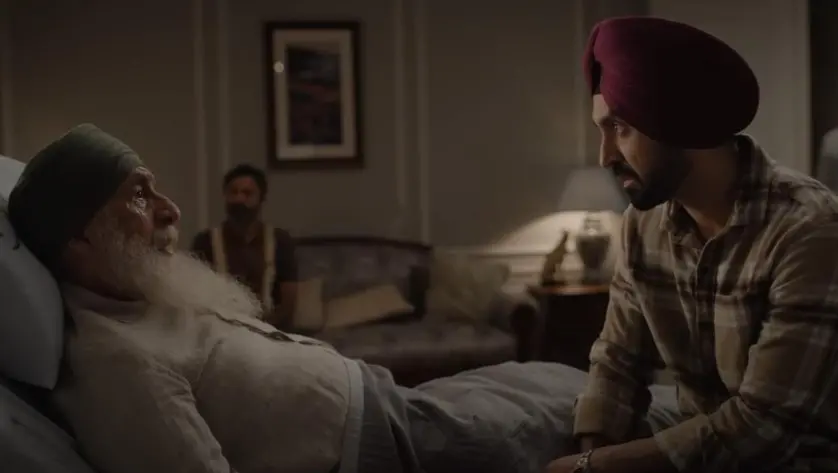
Main Vaapas Aaunga, as its title suggests, is about the universal desire to return. Return where, when, to what and how? The 95-year-old Ishar Singh Grewal (Naseeruddin Shah in his career-best performance), has a stroke but refuses to die as he had promised to return one day and cannot die without fulfilling that promise even if he made it to himself. His memory is all warped, vague and puzzling which his sons and their families fail to grasp so his grandson Nirvair (Diljeet Dosanjh), who lives in London, flies back home to try and make sense of his grandfather’s confusing ramblings where he confuses the British, including Adolf Hitler having descended from Mars which makes them Martians as just one example. His sons and daughters-in-law are literally impatient as he is not dying but the young grandson tries to understand and make sense of his dying grandfather’s ramblings and is convinced that there is some sense in the old man’s amnesiac utterings.
Despite the fact that the tragedy of Partition forms the heart of the story, the flashback of Ishar Singh Grewal as a young collegian (Vedang Raina) unspools a story of a sweet and undying love story between a shy, slightly introvert Ishar and a smart and pretty Jia (Sharvari Wagh), a Muslim girl from a very traditional Muslim family whose growing love for each other is halved, quartered, diced and minced by the tragedy of Partition as Sikhs from the town were forced to escape to the new “India” because their original habitat had now split and had become Pakistan. Almost all the women members from Jia’s family are raped and killed by the Muslim attackers but the film has no intention to point accusing fingers either at the attackers or the attacked.
This craze to ‘return’ on the part of someone to a person, to a memory, or perhaps to a version of ourselves that history has taken away is what defines the central force of the story. The entire film is focussed on the time leaps into the past set against the onset of Partition and the violence that marked it so savagely and inhumanly, but it decides somewhere in the middle to settle for a budding love story between Ishar and Jia. There is a very touching scene showing the young Issar forcibly squatting on the floor of a compound when asked to leave by the military police and refusing to leave.
What holds the film together lies in its passionate making. Not a single thing seems jarring or out of place. Be it the ambience of the present family of Ishar Singh worried about his health, with perfect home care and a nurse in attendance but also eager to see him go. The time leaps between the past and the present are seamless and yet spell out a story distanced from the present. The cinematography, the production design which vacillates almost constantly between the past and the present is incredibly realistic and visually beautiful at the same time. The acting is super if defined in a single word and Naseeruddin Shah in the title role gives his career-best performance over decades of having faced the movie camera and with several National Awards along the way. As his younger self, Vedang Raina seems a bit awkward in some scenes but it fits the characterisation the script has given him.
Jia and Ishar live up to Kabir’s credo, “Haman hai ishq mastana, haman ko hoshiyari kya” (We are intoxicated by love, what use do we have for worldly cleverness?), beautifully composed by AR Rahman. Rahman demonstrates his mastery over every situation in terms of time, period, subject-matter, culture and language with his incredibly beautiful musical score revived to instill the old magic in the music of Main Wapas Aaoonga.
Imtiaz invokes Premchand’s moving fable, Duniya Ka Sabse Anmol Ratan, on what defines an ideal love story and weaves this, sometimes quite gently and often, dotted with the fear of getting separated in love, and later, imbued with the panic of getting killed and the violence on the women.
Imtiaz Ali intelligently weaves this into the Partition script, turning a physical border crisis into a spiritual and philosophical quest. Sharvari Wagh as Ria is more confident than the Sikh boy she falls in love with and is the one eager to consummate the relationship though Keenu (the young Ishar) is quite shy. Rajat Kapoor as Keenu’s elder son is easily annoyed with his son Nirvair desperately trying to make sense of his grandfather’s memories and amazed about his grandfather trying to live up to the promise he made to the girl he even 78 years after he had separated from her and had neither heard of nor seen her since. Though Shah dominates the film for more than half its running time, you never tire of watching him trying to revive his fading memory, his desperate attempts to put in sequence the promise to return to his “homeland” once. The twist in the climax where we are introduced to a surreal scene might jar for some portions of the Generation Zee audience but not for us, senior citizens who have lived through the Partition though never been a part of it.
Main Wapas Aaunga defines its own genre and defies any kind of labeling. It is a beautiful film per se and challenges you to question any point in the long narrative spreading out to a screening time of 166 minutes. It is Imtiaz Ali’s best film till date and to surpass this kind of excellence will pose him with a new challenge.