Everyone has an opinion on Mammootty, but he isn't offering one
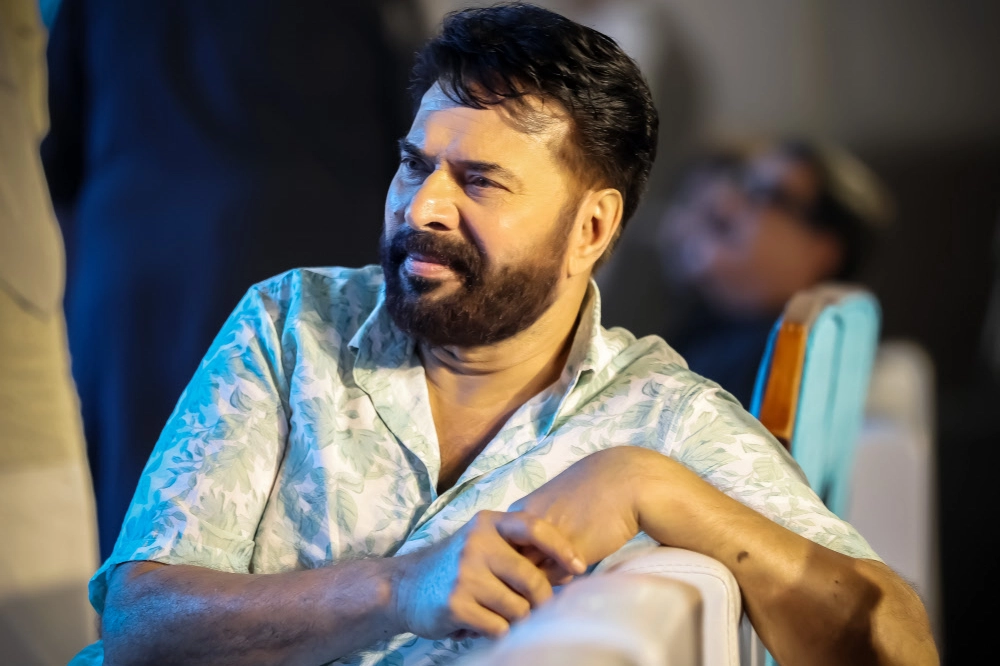
As every public gesture of his becomes a political talking point, the actor's refusal to explain himself is perhaps the most interesting part of the story.
It was all going rather well at the Wayanad rehabilitation township project. Mammootty, in sunglasses, a simple white shirt and mundu, had arrived and was already the cynosure of all eyes as he was given a tour of the newly built homes. He later sat in his car and gave a soundbite, crediting the people for funding the project. But something else caught the eye. Mammootty was seen having a quiet exchange with local CPI(M) Wayanad district secretary K. Rafeeq, who had been following him around, asking him to maintain some distance so that his presence wouldn't be mistaken for an endorsement of the government.
What Mammootty perhaps hadn't bargained for was that a conversation seemingly meant to be private would be picked up by a microphone, leaked and turned into a public spectacle. He hadn't raised his voice or made a public announcement. It was a rather low-key exchange that probably wouldn't have attracted much attention had the microphone not picked up those words. But once they found their way into the public domain, the conversation acquired a life of its own, setting off a controversy that neither party might have anticipated.
But the online response was something else altogether. A section of the CPI(M)'s online supporters took it upon themselves to turn the incident into a mission, unleashing a barrage of personal abuse against him. From declaring that no "megastar is bigger than our secretary" to dredging up his past controversies and perceived misdeeds, Mammootty was suddenly being painted as one of the most despicable people in Kerala. The attacks were not confined to social media either. The episode found its way into television discussions, influencer videos, Facebook posts and endless commentary. For a week or so, Mammootty was at the centre of a controversy that seemed to grow considerably larger than the incident that had triggered it.
And this wasn't to be the last time that an otherwise ordinary public appearance by the actor would be turned into a political statement.
Next came his visit to the Sardar Patel statue in Gujarat, shortly after the National Film Awards ceremony. A section of the Kerala media was quick to interpret it as a sign of Mammootty's alleged political conversion, with some even suggesting that the actor was gravitating towards the BJP. What could have been just another tourist visit by a public figure was suddenly being viewed as a political statement. On a particular television channel, a few media commentators went further, describing the visit as Mammootty's "desperation during the last leg of his journey to bag the Dadasaheb Phalke Award", while also attributing it to an alleged attempt to shield his son Dulquer Salmaan from further ED raids.
The commentary soon took an ugly personal turn, with one media person even describing Dulquer as "equally a coward" for supposedly being afraid to mention beef and choosing chicken and fish instead when asked about his favourite food. It was no longer just about questioning Mammootty's supposed political leanings. His family, his ambitions and even his son's dietary preferences were now fair game.
A few weeks later, Mammootty was seen in the company of DYFI and SFI Youth leaders at his home. They even posted pictures online, making no effort to hide their delight at the meeting. That was apparently all it took for his online detractors to once again take up arms against the "megastar" who had apparently wronged their beloved comrade.
And then came the latest episode: Mammootty visiting the home of BJP Kerala state vice-president, advocate B Gopalakrishnan, after missing his daughter's wedding ceremony. The visit triggered yet another barrage of abuse. Many questioned the propriety of Mammootty's decision to visit a politician known for his Islamophobic views, arguing that such an association could set a dangerous precedent. Notably the politician had already taken aim at Mammootty following his State Film Award win, taking to Facebook to question the government's choice of what he suggested was a disproportionately large number of Muslim awardees A section of the media went a step further, branding the visit a "betrayal."
What is particularly interesting through all these episodes, however, is Mammootty's silence. Even when party leaders came out in his support, the actor chose not to offer an explanation, issue a clarification or even acknowledge the uproar. He simply carried on. He continued acting, doing charity, attending public events and meeting people from all walks of life. There was no elaborate exercise in damage control, no attempt to win back anyone's approval and certainly no public declaration of where his political sympathies lay.
Perhaps the closest he came to addressing the mounting controversies was at a recent public appearance, when he remarked, "The best way to tackle evil is to make your enemies your friends." Whether it was intended as a response to the criticism surrounding his recent interactions or simply a philosophical observation is anyone's guess. But coming amid all the noise, the remark was certainly hard to miss. It was also characteristically indirect. Mammootty didn't name anyone or offer a clarification. He left the interpretation to everyone else.
That brings us to an important question. Does a public figure owe every section of the public an explanation for whom he meets or visits? Not really. Mammootty's silence can be interpreted either as a conscious decision to stay out of political crossfire or simply as a refusal to dignify every controversy with a response. And as a public figure, he has every right to maintain cordial relationships across the political spectrum. He can visit a Congress leader's home today and a BJP leader's daughter's wedding tomorrow without either visit automatically being treated as a political endorsement.
Of course, this doesn't mean that public figures are exempt from scrutiny over the company they keep, particularly when those they associate with have made contentious public statements. But scrutiny is different from demanding political conformity, and a social visit need not automatically translate into an endorsement of someone's ideology.
Here's what makes this even more interesting. Mammootty is astute enough to know that visiting the home of a BJP leader, particularly one whose public positions have attracted considerable criticism, would invite scrutiny. Yet he went ahead with the visit. Similarly, a public clarification or apology on social media might have helped douse the fire that followed the Wayanad township incident. He could have called a press conference, given an interview and perhaps even turned the tide in his favour. But he did none of those things. Whatever his reasons, he seems unwilling to let the competing political expectations of Kerala's public sphere dictate whom he chooses to meet or associate with
In fact, the dissection of Mammootty, both as an actor and as a person, is hardly new. I honestly cannot think of another actor in Malayalam cinema whose personality, choices, abilities, insecurities and even his right to occupy a particular space in the industry have been scrutinised and ridiculed with such persistence.
I remember reading a magazine interview, possibly in India Today, in which Mammootty spoke about being humiliated by people he thought had his back during his lean period in 1986. What stayed with me was his recollection that when his fortunes changed, he chose not to return that humiliation in kind. He believed that wasn't his job.
I find that remarkably revealing. Silence doesn't necessarily mean you aren't hurt. It could simply mean you have decided that responding to every provocation isn't how you want to spend your life. We don't know what happens in private, and I am certainly not suggesting that Mammootty is above criticism or that every silence should be mistaken for wisdom. He can be stubborn, contradictory and occasionally difficult, like anyone else. But there is something to be said about his apparent unwillingness to turn every slight into a public confrontation.
Interestingly, this is also where his professional instinct comes into play. Over the years, questions about his acting, versatility and relevance have often been answered through his choice of films and performances rather than through public rebuttals. His career has seen him experiment, stumble, reinvent himself and return with performances that have challenged earlier perceptions of him. Not every gamble has paid off, but the willingness to keep taking them has been a defining feature of his journey.
At this stage, it is perhaps natural that he isn't particularly interested in seeking validation from those who have already decided what they think of him. Mammootty may not always get to control the narrative around himself, but he has certainly retained control over what he chooses to do next. Let's face it, even a clarification could snowball into another round of uglier reactions. Four decades in the business might have taught him that sometimes, saying nothing is the wiser option. So while others remain occupied with defining him, he seems content to keep redefining himself. That's what Mammootty has always done.