Kerala votes for a political reboot
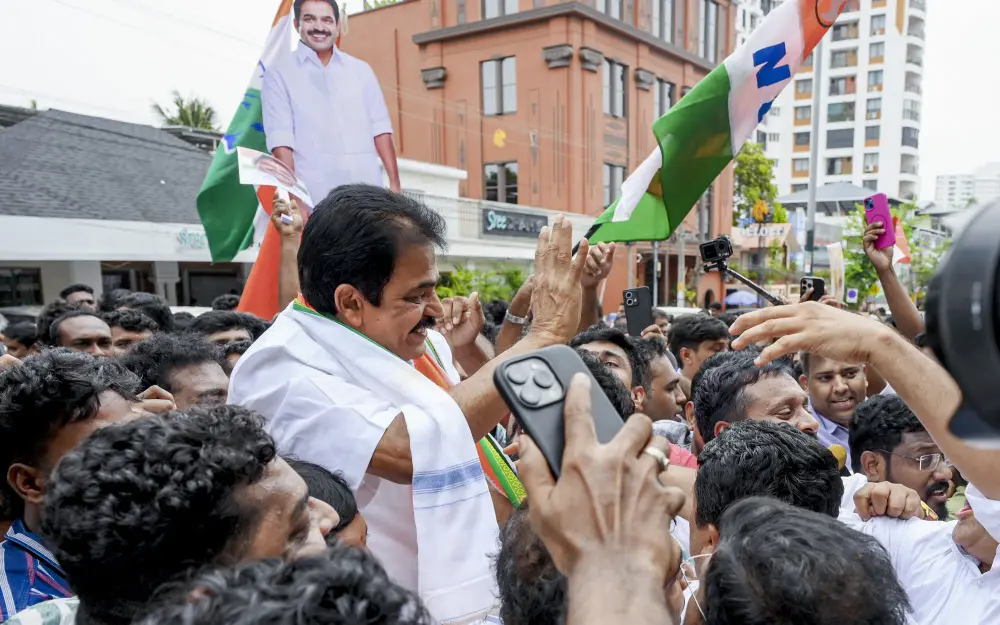
The real winner of the 2026 Kerala election is democracy itself.
For weeks, the election was projected as a neck-and-neck battle. Pre-poll surveys, exit polls and even AI-driven voter analyses failed to capture what Malayalis were actually thinking inside polling booths. Some predicted a narrow UDF victory. Others, including sections of the political establishment, expected a third consecutive term for the LDF led by Chief Minister Pinarayi Vijayan.
Instead, Kerala delivered a political shock. The LDF was reduced to 35 seats while the Congress-led UDF crossed the 100-mark in the 140-seat Assembly. At a time when democratic systems across the world increasingly appear jaded, polarised and vulnerable to manipulation through political tactics and social media narratives, Kerala’s verdict stands out as an example of collective public wisdom cutting through the noise.
The one leader who consistently predicted a landslide outcome was Congress leader V.D. Satheesan. His “100-plus seats” claim was widely mocked as campaign-season exaggeration. Today, that prediction has become political capital. Satheesan now has both the mandate and the credibility to shape Kerala’s next phase.
The scale of the Congress victory also changes the internal power equations within the UDF. With the Congress itself bagging 63 seats, the Muslim League’s bargaining power, with 22 seats, is reduced compared to previous coalition governments where narrower margins made allies indispensable.
But Kerala politics rarely stays stable for long. If factional rivalries within the Congress intensify over cabinet positions, leadership ambitions and regional influence, smaller allies could once again regain leverage by aligning with competing camps inside the party.
Anxious Moments
But what is more important question is what comes next for Kerala.
Across WhatsApp groups, tea shops and apartment discussions, one concern is already surfacing repeatedly. After being out of power for a decade, will the UDF return with a sense of revenge – not ideological revenge, but the urge to regain access to power, contracts and influence?
Kerala’s biggest development projects are now linked to investments running into lakhs of crores of rupees. Vizhinjam Port, the expansion of Technopark and emerging infrastructure projects could reshape the state’s economy over the next decade. There is widespread concern that the new government may slow down or rework projects simply because they were initiated under the previous regime.
That would be a costly mistake. The LDF government faced criticism over corruption allegations, governance style and political arrogance. But even many critics acknowledge that it pushed ahead with infrastructure development, welfare delivery and digital governance reforms.
Mixed Record
Kerala witnessed significant expansion in e-governance systems during the last decade. Digitisation of government services, file tracking systems and online documentation reduced friction for ordinary citizens trying to secure certificates and access services.
But implementation remained uneven. Land records digitisation, one of the most critical reforms for ordinary people and investors alike, remained incomplete and patchy. Many departments resisted transparency and procedural reforms. Officials slowed implementation, diluted proposals or buried them inside bureaucracy.
This is where the new government faces its first major test. Kerala cannot afford governance driven by political one-upmanship. It needs continuity where continuity works.
Trouble Ahead
The state’s financial condition makes this even more urgent. Kerala’s economy has long depended on a silent support system: Gulf remittances. More than two million Malayalis work abroad, largely in GCC countries. Their money has sustained households, real estate, gold markets and consumer spending for decades.
That model is now under pressure. The ongoing instability in West Asia, especially tensions involving Iran and the United States, has created uncertainty across Gulf economies. Construction, logistics, retail and oil-linked sectors – all major employers of Malayalis – are facing pressure.
For Kerala, this is not a distant geopolitical issue. A slowdown in the Gulf quickly reaches homes in Kozhikode, Kochi and Thiruvananthapuram through job losses, delayed remittances and weaker consumer spending.
The new government cannot control global conflicts. But it can stop behaving as if Kerala’s economy can continue depending indefinitely on remittance-driven consumption. That means creating new economic engines inside the state. This is where technology, innovation and industrial policy become central.
Educated Vision
Kerala has spent years talking about becoming a knowledge economy. It has hosted conferences on AI, deep tech, the blue economy, startups and digital transformation. But the gap between announcements and execution remains large. Technopark and the wider IT ecosystem have created opportunities, but Kerala still struggles to convert its educated workforce into large-scale high-value employment.
Artificial intelligence now adds a new layer of urgency. AI is already reshaping global IT services and white-collar jobs – sectors on which Kerala’s middle-class aspirations heavily depend. Routine coding, support services and back-office work are increasingly vulnerable to automation.
The challenge is not just technological. It is educational. Kerala’s education system still rewards rote learning and examination performance over problem-solving, creativity and interdisciplinary thinking. Syllabus reforms have been discussed for years, but implementation repeatedly gets trapped between bureaucracy, political hesitation and institutional resistance.
The UDF government must treat education reform as an economic survival issue rather than a long-term policy discussion. Engineering graduates are entering a labour market changing faster than college curricula. Students trained for yesterday’s jobs will struggle in tomorrow’s economy.
Opportunities Await
Kerala still has advantages. The state has strong literacy levels, global exposure, an active diaspora and relatively better digital infrastructure compared to many other parts of India. It also has the potential to build specialised sectors around space technology, maritime logistics, healthcare innovation, tourism technology and clean energy.
Vizhinjam Port alone could trigger a wider logistics and industrial ecosystem if supported properly through policy and infrastructure.
But the state needs faster execution and a more industry-oriented mindset. One of the LDF government’s biggest failures was not the absence of ideas. It was the failure to convert discussions into outcomes.
Kerala hosted countless conferences, investment meets and technology summits over the years. There were presentations about AI in education, blue economy opportunities and startup investments worth thousands of crores. Kerala was repeatedly projected as the next major innovation destination.
Shallow Focus
Yet many proposals disappeared into government pipelines without visible follow-through. The event often became more important than the outcome.
At the same time, governance increasingly became filtered through social media optics. Ministers and political leaders focused heavily on reels, influencer interviews and carefully managed online engagement. The assumption appeared to be that visibility on social media reflected public approval. The election results showed otherwise.
The LDF leadership seems to have confused online engagement with public trust. Genuine feedback from citizens often failed to reach decision-making levels. An echo chamber within the system filtered out differing views.
That is the biggest lesson the new government must learn. Kerala’s next administration cannot govern through screens, presentations and curated feedback loops. It must reconnect directly with people. Talk to the family waiting years for a land record correction. Listen to young graduates struggling to find meaningful jobs despite degrees. Understand the anxieties of Gulf families facing uncertainty.
The state also needs a proper feedback mechanism connecting policymakers, industry, academia and ordinary citizens. Policy papers should not remain conference documents. Development announcements should be measured by what actually gets built.
Third Option
The CPM, meanwhile, also faces a moment of introspection. The party still retains a strong organisational structure and a committed voter base. But it must resist the temptation to oppose every government move through street-level confrontation alone. Kerala needs a functional opposition, not permanent political warfare.
Both the UDF and the LDF should pay attention to another number from the election results: three. The BJP has won three seats in Kerala – still small, but politically significant in a state where the party once struggled for relevance.
The BJP’s core argument has been consistent: that neither front has managed to modernise governance or meet the aspirations of a changing Kerala. That argument has not fully succeeded yet. But every cycle of political disappointment gives it more space.
The UDF has received a rare second chance with a massive mandate. But this mandate is not purely an endorsement of extraordinary governance promises. It is also a reflection of voter fatigue with the previous government. That makes this victory both an opportunity and a warning.
If Kerala repeats familiar patterns – corruption controversies, factional fights, stalled reforms and governance driven by optics – voter frustration will deepen further.
And in a rapidly changing economy shaped by AI, geopolitical instability and technological disruption, Kerala may not have the luxury of wasting another five years.