The sage who reimagined Hinduism: Remembering Sree Narayana Guru
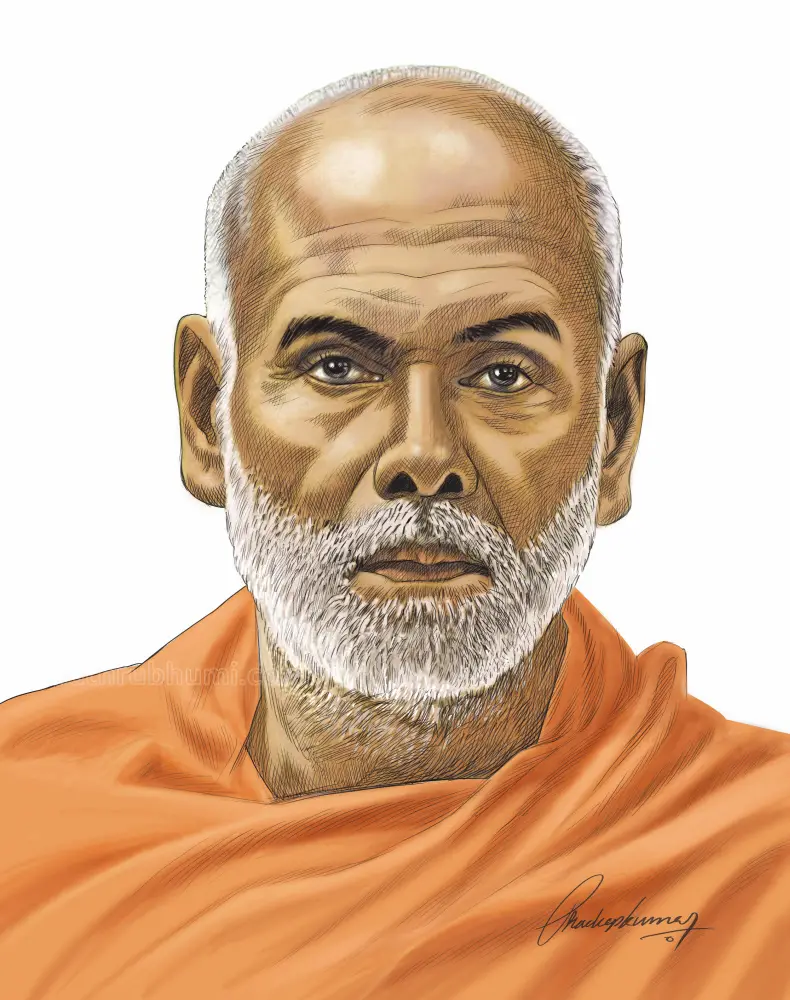
As Mathrubhumi Publishers release the Malayalam edition of my newest book, The Sage Who Reimagined Hinduism, a few days after the Vice-President of India released the English edition at the Sivagiri Ashram, I find my heart full of reverence and gratitude. As the Member of Parliament for Thiruvananthapuram, the city that hosts Chempazhanthy, the birthplace of Sree Narayana Guru, the soil where his first footsteps touched this earth, I feel this book is the fulfilment of an unspoken commitment to my constituency. To breathe in this sacred air, to stand on this blessed land, fills me with a profound sense of pride and humility; to author a book about its greatest son, that seeks to make him better known to non-Malayalis, intensifies both emotions.
This moment of publication is not only celebratory—it is deeply spiritual. Even the memory of the Guru carries a transformative energy, a power that uplifts individuals and reawakens the conscience of society. His life, his thoughts, his vision, do not belong to the past. They are timeless. They are active truths, still shaping our present and lighting the path ahead.
In the suffocating gloom of late 19th -century Kerala, Sree Narayana Guru emerged not as a revolutionary brandishing weapons but as a luminous sage wielding the dual power of enlightened thought and compassionate action. He led a quiet revolution, where the liberation of the mind ignited the dismantling of injustice. His philosophy, radical yet deeply pragmatic, forged a synergistic model based on castelessness, education, and collective enterprise—an unbreakable chain of progress, as indispensable today as it was then. In my book, I have sought to reflect on the Grace of Equality that Guru embodied so naturally.
Legends like Sree Narayana Guru are not confined to history; they create it. And they continue to influence it until the very end of time. His was not a life of noise or rebellion, but one of quiet revolution, of steady, sacred change. The Guru looked upon a society shackled by caste, stagnated by ritual, and paralyzed by inherited hierarchies—and he chose not to condemn, but to reimagine. Though he viscerally rejected the injustices he saw around him, he offered a vision not of destruction, but of renewal; not the storm that uproots, but the rain that nourishes; not anger, but awakening.
“One caste, one religion, one God for all mankind”—these words were not mere slogans. They were a spiritual thesis, a philosophy of radical equality and universal brotherhood. In their simplicity lies their power. Guru believed that difference must never become division, and that it is compassion, not custom, that must guide our lives. Even after one and a half centuries, the relevance of his vision has only intensified. His message, rooted in dignity, unity, and reason, is the message the world still desperately needs today.
The Guru’s genius was never limited to diagnosing social ills. His true brilliance lay in the alternative he envisioned: a luminous world where liberation is not granted by the powerful, but reclaimed by the oppressed. It was a world where freedom is not charity, but a birthright; a world where the spiritual and the social, the moral and the material, are not divided, but woven into a single fabric of human flourishing.
He gave us a triad of upliftment: castelessness, education, and economic self-reliance. These were upheld not as abstract ideals, but as practical instruments of transformation. To the Guru, no one could be spiritually free while mentally enslaved. No one could be dignified in thought while degraded in labour. His message was not only universal, it was profoundly human.
The Guru’s immortal teachings have made a profound impact on Kerala. There is no Malayali who cannot quote his famous line “matham ethayilum, manushyan nannayaal mathi”, (“whatever the religion, it is enough that a man be good”) As a new entrant into politics, I paraphrased it in my very first election speeches to say, “rashtriyam ethayilum, rashtram nannayaal mathi” (“Whatever the politics, it is enough that the nation do well”). I believe it is a sentiment of which the Guru would have approved, and I have continued to repeat it.
The Guru’s influence was not limited to Kerala in his lifetime. His teachings reached far beyond our shores—to Sri Lanka, Singapore, Malaysia, and beyond—through the Malayali diaspora and through seekers who found in his words a spiritual clarity, a moral compass. In fact, Mahatma Gandhi, the Father of our Nation, himself visited Sree Narayana Guru at Sivagiri in 1925, and called the Guru “the greatest and most revered of all the social reformers in India." Such was his stature that global leaders, thinkers, and spiritual scholars acknowledged his unparalleled contribution to social and spiritual thought. His philosophy transcended barriers; his life stands as a shining example of how inner awakening can lead to outer change.
And yet, sadly, he remains largely unknown today to the vast populace of India. Where every neighbourhood in Thiruvananthapuram boasts a shrine to the great sage, his name evokes a blank stare of incomprehension from nine out of ten non-Malayalis elsewhere.
My book is a modest attempt to ameliorate those numbers. I want to tell my non-Keralite compatriots that Sree Narayana Guru’s brilliance did not lie solely in pointing out the fractures of Kerala society, but in offering a living, breathing alternative that applies to Hindus everywhere. He saw that true change would not come from tearing down, but from transforming within. He believed that no one could be free until all were free, and that humiliation of even one soul was an affront to the Divine itself. To see another as lesser, he taught us, is not just a moral error; it is a spiritual illusion. He envisioned temples opened not only to people, but to the light of reason. He imagined schools as sanctuaries of wisdom, and tools of trade not as burdens of toil, but as instruments of dignity and transformation. Sree Narayana Guru's philosophy, radical yet profoundly pragmatic, offered a transformative pathway to universal human freedom and dignity.
Sree Narayana Guru was, in the truest sense, a cartographer of compassion, mapping a future where every human being could stand tall, not because of their birth, but because of their worth. The rest of India, and indeed the world, can still learn much from this sage of silence. His life was a hymn to human dignity. His teachings were a scripture of universal compassion. And his legacy remains a flame still burning for those who seek not just to live free, but to live fully human. Guru ji did not merely reform a fractured society; he reimagined the very essence of human potential, forging a legacy that continues to illuminate the path towards a more equitable and liberated world. Let us honour him by living his ideals—in our homes, our schools, our governance, and our daily lives.
If my book seeks to accomplish anything, it is to encourage each and every one of its readers to commit themselves to the Guru’s goals: to build a society where no one is denied their dignity; to speak not of caste, but of character; to see not labels, but light. May the eternal flame of Sree Narayana Guru continue to guide us all, not just through this one book, but in every step we take towards justice, unity, and truth.