The Cartography of Belonging
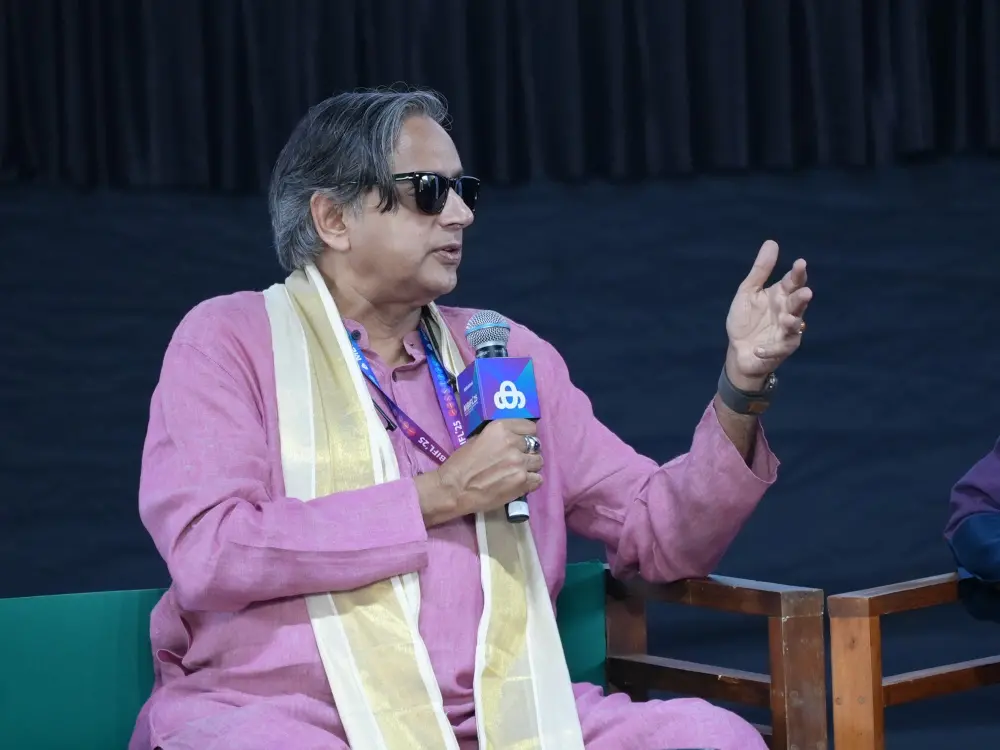
This month, I find myself speaking at two literary festivals in Kerala – at the Kerala LitFest on Kozhikode Beach and then at the Mathrubhumi International Festival of Literature, of which I am patron, in my own constituency, Thiruvananthapuram. These settings, one steeped in the timeless serenity of Kerala’s heartland, the other in bustle of the state capital, compels a consideration of what truly constitutes home. For a writer, home is often an architecture of the mind, a sanctuary constructed from language and memory. But for one whose life has been a relentless, decades-long trajectory across continents and across the fraught divide of global service and local politics, the question of where the heart truly resides is far less simple.
For me, ‘home’ is a term that has undergone an essential, sometimes unsettling, metamorphosis. It is not a static point on a map, but a dynamic, evolving commitment—a concept that has stretched from the abstract universality of a global ideal to the profound, tangible particularity of a constituency in Thiruvananthapuram. It is, ultimately, a magnificent synthesis of the three vital pillars of our existence: People, Places, and Planet.
My initial, protracted definition of home was the Planet itself. For twenty-nine years, my allegiance was pledged to the ideals of the United Nations. In the grand, sprawling, and often frustrating theatre of global diplomacy, my identity was that of the global citizen. My ‘Place’ was less a fixed location than a succession of temporary outposts: Geneva, Singapore, New York, and a dizzying inventory of conflict zones and suffering nations. My daily life was an exercise in transcending national borders, finding common ground, and championing a universal morality, that of our common humanity, rooted in the United Nations Charter.
In that life, my ‘People’ were a majestic abstraction: the six, later seven, billion inhabitants of the globe, the displaced, the oppressed, the war-ravaged, the aspirational youth across the world. My sense of belonging was intellectual, a fierce loyalty not to a particular flag, but to the collective enterprise of multilateralism. My writings from this era—many of which were cerebral, cosmopolitan, steeped in the grand narratives of history—reflect a mind grappling with the epic, macro-level challenges facing humanity, from genocide prevention to the intricacies of global climate negotiations. But I still managed, in this time, to look back on my own land through creative fiction, both satirical and savage, in three largely well-reviewed novels.
In the UN, home was a deliberate state of unmooring. You sacrifice the emotional comfort of the known for the moral conviction of the universal. The sense of belonging was derived not from shared cultural idiom but from shared, high-minded values. I was a child of the world, and my home was the idea of a better, more equitable world order. This was a sophisticated, if somewhat rarefied, home—a sanctuary built on principles, not on paddy fields.
The decision to forsake the gilded cage of international civil service for the dust and din of Indian public life sixteen years ago was not a mere career shift; it was a profound act of re-rooting. I transitioned from addressing the UN General Assembly to answering questions about water scarcity in a village Panchayat and promoting the idea of a UAE consulate for travellers from my state. The shift was seismic: from the Planet to a very specific, demanding Place—my beloved Kerala, and even more specifically, my constituency, my karmabhumi.
Suddenly, the theoretical gave way to the tangible. My ‘People’ narrowed down from abstract humanity to my voters, my neighbours, the teeming, vibrant, and fiercely articulate constituents of Thiruvananthapuram. The meaning of home ceased to be a high-flying, philosophical ideal and became something grounded, visceral, and utterly real. It is the smell of the monsoon hitting the laterite soil, the taste of a truly authentic sadya, the intricate rhythm of Malayalam spoken in its native cadences.
This home, the home of the politician, is far more demanding. In politics, you are accountable for the specifics: the unpaved road, the local clinic, the validity of a ration card. This is where the sheer intellectual breadth cultivated at the UN must be distilled into effective, granular public service. Returning to my ancestral soil has been profoundly restorative, compelling me to shed the aloofness of the global expert and embrace the immediate, messy complexity of local identity. Kerala, with its fierce political engagement and rich cultural syncretism, provides the essential anchor, the Place that lends gravity and purpose to all my previous experience. I am now tied to a specific community, obligated by its faith and defined by its destiny.
So, what is home to Shashi Tharoor today? It is neither the world – despite the enthusiasm of those in Kerala who call me a “Vishwa-pouran”, a world citizen -- nor the constituency exclusively. It is a double-rooted existence: a wonderful synthesis where the global mind must meet the local heart. My rootedness in Thiruvananthapuram provides the necessary emotional and cultural ballast, while the three decades spent at the UN furnish the moral and intellectual framework.
My perspective on People, Places, and Planet is therefore inherently layered. When I speak to my constituents (the People), I frame their needs within the context of global and national economic forces. When I celebrate the cultural heritage of Kerala (the Place), I do so with an awareness of its unique position as a microcosm of global migration and intellectual ferment. And when I speak of the Planet—be it climate justice or multilateral reforms—I do so not merely as an internationalist, but as a political servant who knows these global challenges directly impact the lives of specific families in a specific place, my “home”.
Home is, for me, the confluence where the universal river meets the particular sea. It is the comfortable tension of having a passport that is Indian and a mind that remains global. It is the ability to walk the streets of my constituency and know that the local concerns I champion are, in their essence, universal human struggles. This duality is my strength, my burden, and my deepest source of belonging.
To be home is not to be static; it is to be accountable—accountable to the soil you walk upon, the people you represent, and the ideals you have served. And in the inspiring setting of Kerala, I find a powerful symbol of this synthesis: a Place that welcomes global People for dialogues concerning the fate of the Planet. It is here, at the heart of my rooted reality, that I feel most wholly, truly, and complexly at home.