Arundhati VS Moditva: Sad days for democracy
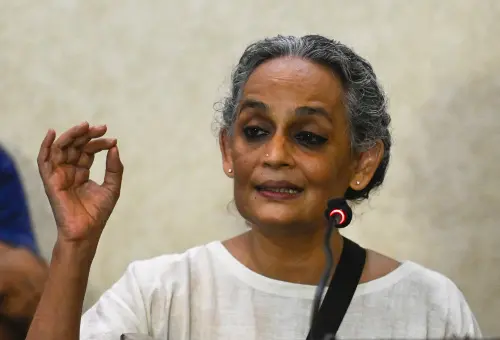
This week the Delhi Police will file formal charges in a fourteen-year-old pending case against the author Arundhati Roy, relating to remarks she made at a conference on Kashmir in Delhi in October 2010. Alongside a motley array of Islamist radicals, left-wing intellectuals and sympathisers of secessionism, Ms Roy had declared, perhaps naively, that "Kashmir is not and has never been an integral part of India", thereby giving support to the votaries of the state’s separation from the rest of the country, who applauded her enthusiastically at the time.
Back in 2010 a magistrate’s court had taken note of her statement and registered a case against the novelist, but not proceeded with it. The logic was that merely registering a case would be enough to convey the state’s disapproval and convey a warning to the writer not to repeat such remarks. Preaching secession of any part of a country is illegal in most nations, and India is no exception.
The wounds of our previous Partition on religious grounds by the departing British in 1947 have still not healed, and the festering sore of Islamist Pakistan on its western border, constantly fomenting (and intermittently launching) terrorist attacks into Indian territory, intended to promote Kashmir’s secession from India and merger into Pakistan, makes the expression of such sentiments particularly fraught in the Indian context. The fact that people are still dying in Kashmir at the hands of a violent secessionist movement, actively armed, financed and directed by elements in Pakistan, makes matters worse. In the context of the militancy besieging India, Ms Roy’s statement was indeed incendiary, as well as unwise.
But to take action today, fourteen years later, smacks of overkill. Much though I admire Ms Roy as an individual and a writer, I do not always highly rate her political views and judgements. There is indeed overwhelming historical evidence for Kashmir having always been an integral part of India, and to aver otherwise, suggests either ignorance or innocence, neither of which are virtues when you choose to pronounce your views on such sensitive topics. Ms Roy’s earlier writings romanticising Maoist jungle killers as “Gandhians with guns”, for instance, had made many friends and admirers shake their heads with sadness and despair. If you are so willing to be taken in by any radical with a grouse against the Indian state who prefers to kill to advance his cause, why should the Indian state not look at you askance?
Still, the then-Congress led government in Delhi in 2010 did not find it necessary to prosecute the writer for her remarks at that time. The now-ruling BJP, then in opposition, demanded it vociferously, but the Delhi Police took the view that Ms Roy’s words, however misguided they may have been, were not seditious. At the time, the central government was engaged in a peace-and-reconciliation dialogue in Kashmir to restore normalcy there, and probably felt that prosecuting her would constitute a needless distraction from their core objective. Though the presiding Magistrate overruled the police and directed that a case be registered, it was not proceeded with.
Today, however, equations have changed. The BJP is in power at the Centre, and in 2019 they brought about some far-reaching changes in Kashmir, including bifurcating the state and reducing Kashmir’s status to a Union Territory directly ruled from Delhi. Section 13 of the Unlawful Activities (Prevention) Act, known as UAPA, under which Ms Roy’s prosecution is to be proceeded with, covers offences and penalties, including "advocating, abetting or inciting the commission of an unlawful activity", punishment for which can extend up to seven years of imprisonment and a fine. This would strike most of us as excessive for a careless choice of words. Criminalising free speech, however offensive it may sound to the authorities, is hardly an action that befits a democracy.
The revival of the Roy case is clearly intended to send a broader signal -- that despite having come back to power with a reduced number of seats that have obliged it to a form a coalition with several smaller parties in order to attain a majority, the BJP is determined to remain just as intolerant of dissent and criticism as we in the Opposition have been saying in the last ten years. This is a government that delegitimises disagreement as 'anti-national' and urges its critics to 'go to Pakistan', as if there is no room for their dissenting views in India. And yet the same BJP government loves to preach to the world about the exemplary democracy it runs in a land it constantly (and unabashedly) calls 'the Mother of Democracy'.
The Roy case, if the government proceeds with it as it seems to want to, risks showcasing all the most unattractive features of the Moditva regime currently in office. A few ill-chosen words fourteen years ago pose no security threat to the state whatsoever, and seeking to punish them reveals a level of pettiness unworthy of a major government. The well-established principle laid down by Mahatma Gandhi that Indians are free to say whatever they wish against the government so long as they do not advocate violence, has been discarded. And the BJP government has never understood that the core idea of free speech is that it includes the right to air unpalatable views, even those rejected by the majority of the population. Instead, the BJP wants to send a tough signal to dissenters within India that conformity is expected, else consequences will follow. This will lower the bar for free speech even more.
Externally however, the prosecution and likely conviction of a well-respected, popular and charismatic prize-winning writer held in high regard in the West will turn out to be an 'own goal', giving yet more fodder to those who have already downgraded India from a democracy to an 'electoral autocracy' and lowered its standing in the World Press Freedom rankings.
Ms Roy may, or may not, briefly go to jail. But the images of her being led there will be seared into the global consciousness about India and will do Mr Modi no credit. She may be in a cell, but he will end up in the global doghouse. It is not too late to avoid such an ignominious fate by simply calling off the prosecution.