Khyrunnisa turns life's everyday mishaps into laughter in 'Happy Go Funny'
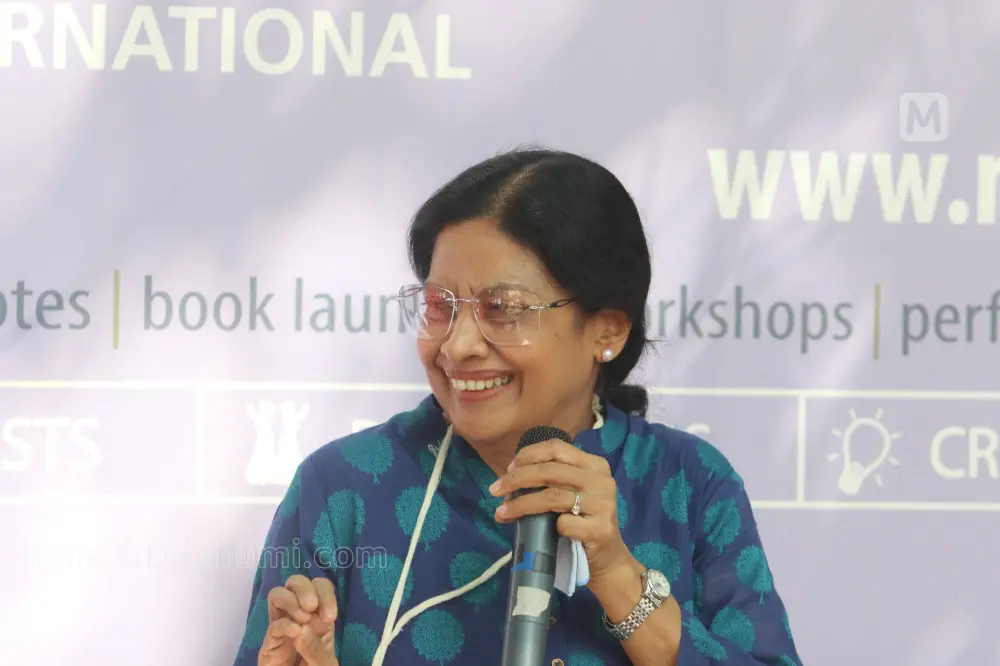
I had the pleasure recently of releasing Happy Go Funny: The Lighter Moments of Life by Khyrunnisa, a book that proves you do not need a grand philosophical framework to understand the universe. You just need a sense of humour.
Because if you have ever tried to navigate a waterlogged pavement during the monsoon, only to have a loose concrete slab rise like a treacherous seesaw and deposit you into a gutter, you know that life is not a grand tragedy. It is diverting comedy, only waiting for a perceptive observer.
Khyrunnisa is an author who does not merely observe life's absurdities; she actively acts as a highly attractive lightning rod for them. As she notes in the book, some people are born disaster-prone, some achieve disasters, and others have disasters thrust upon them. She appears, with enviable consistency, to qualify under all three headings. It appears that Murphy's Law, having exhausted opportunities elsewhere, finally settled down in Thiruvananthapuram and took up permanent residence in her household. One suspects it now pays rent.
What’s the secret of this book's remarkable charm? It lies not merely in the incidents it recounts, but in the eye that observes them. Humour is perhaps the most difficult literary form to master. Tragedy merely asks us to sympathise. Comedy demands something far more exacting: precision, timing, restraint and, above all, affection. You cannot make readers laugh at humanity if you secretly dislike human beings. Khyrunnisa's writing succeeds because even when she pokes fun at people, she likes them too much to ridicule them cruelly. She laughs with them, and, most often, at herself.
There is an old saying that comedy is tragedy viewed from a sufficient distance. She improves upon the formula. She barely waits for the distance. By the time the rest of us have finished complaining about an unfortunate incident, she has already found the punchline, whether it is to do with a monkey snatching her bag, or ants taking over a jar of premium foreign pistachios, or a kitten trapped in the bonnet of a car.
Another hallmark of Khyrunnisa’s humour is that she never exaggerates. She never strains for comedy. Reality does all the heavy lifting for her. She simply allows reality to expose its own delightful absurdity. Many writers go looking for extraordinary stories. Khyrunnisa has discovered something far rarer, that ordinary life is already extraordinary, provided one pays sufficient attention. Most of us experience these absurdities, grumble about them, and move on. She quietly turns them into literature.
As engaging as the whole book is, the essays closest to my heart are those that are so deeply, unapologetically rooted in Thiruvananthapuram. As the parliamentary representative for this beautiful city, I read her descriptions with an immense sense of recognition. Khyrunnisa treats our city not just as a backdrop, but as a living, breathing character, portraying it with an affection that is beautifully tempered by sheer local frustration. The finest regional writers do precisely this. They persuade us that a place is not merely a collection of streets and landmarks, but a personality with moods, quirks and contradictions. She captures Thiruvananthapuram perfectly: green and spectacularly lush after the rains, culturally vibrant, but also hilariously beset by infrastructure woes, traffic jams, and the frantic tensions of rapid modernisation. Only someone who truly loves a city earns the right to tease it so mercilessly.
But the true pinnacle of her regional satire belongs to ‘A New Kerala for Mahabali’. Here, she brilliantly imagines our mythical King Mahabali making his annual return to a modernising Kerala during Onam. The paradise he remembers has acquired traffic congestion, environmental anxieties, consumerism and a host of thoroughly modern inconveniences. Watching a legendary king navigate our bumper-to-bumper traffic is both incredibly funny and quietly revealing. What should Mahabali now bring on his annual visit? Antibiotics for allergies, digestive tablets for the rich food, mosquito repellent for the dengue, face masks to combat the pollution, plus, ideally, a helicopter to avoid the traffic. Satire has always worked best by allowing the past to hold up a mirror to the present, and Khyrunnisa accomplishes exactly that.
Beyond the geographic eccentricities, the vast bulk of this book mines pure comedy from the absolute battlefield that is everyday domestic life. It reminds us that the most dramatic theatre in our lives is rarely found in boardrooms or war zones. It is found in kitchens, bathrooms, bedrooms and drawing rooms, where appliances rebel, household objects develop personalities, and perfectly ordinary mornings descend into glorious chaos.
A deeper reason why Khyrunnisa’s humour endures is because she reminds us that comedy is not the opposite of seriousness. It is another way of paying attention. Anyone can complain about a delayed train, a stubborn umbrella or a broken appliance. Very few can, like her, return home and discover, hidden within those everyday irritations, something that illuminates the human condition. She possesses a literary alchemy that turns leaden annoyances into pure comedic gold.
What I find most wonderful about her perspective is its boundless, radiant generosity. In the hands of a lesser writer, everyday frustrations could easily devolve into cynical complaints or weary sighs. But Khyrunnisa infuses the mundane with warmth, treating everyday incidents gone wrong and the bizarre characters she encounters with a deeply affectionate grace. Happy Go Funny is not merely a collection of humorous columns; it is a profound philosophy of resilience. It is a guide on how to live cheerfully in a world that is constantly dropping its own metaphoric plate of hot food right onto your clean carpet.
Ultimately, this is the true, enduring magic of Khyrunnisa’s writing, and it is precisely why Happy Go Funny is such a magnificent, triumphant addition to contemporary Indian literature. She holds up a delightfully tasteful, remarkably sharp mirror to our ordinary life-world, transforming our daily irritations into badges of honour.
We live in an era dominated by relentless, stressful news cycles, endless traffic honking, hyper-inflated rhetoric, and digital systems that seem perpetually "down." In a world that often takes itself far too seriously, this book arrives as a beautiful, necessary intervention. It reminds us that the absolute best antidote to the universe's chaos is not despair, but a hearty, unadulterated guffaw.
Author: Khyrunnisa A.
Publisher: Westland Books
Price: 399/-