How Bollywood and South Indian Cinema turn cities into living characters
Arjun Appaduraii has written about ethnoscapes (spaces produced through inflow of people such as immigrants, refugees, etc.) technoscapes (inflow of technology, etc.), finanscapes (flow of global capital, commodities, etc.), mediascapes (the repertoires of images and information) and ideoscapes (ideological shifts connected to Western world views. These are different ways of looking at the global cultural flows strongly influenced by perspective, overlapping, and the rapidly shifting instability and mutability of global cultural flows. Indian filmmakers are fond of making the city the central protagonist of a film.
Mumbai finds beautiful reflection in several films of the 1970s and 1980s. Three brilliant examples are Kamla Ki Maut (1989) by Basu Chatterjee, Katha (1982) by Sai Paranjpye and Gharonda (1977) produced and directed by Bhimsain Khurana. Kamla Ki Maut is set in a Mumbai chawl revealing the underbelly of the city through an introspective journey by one of its members when a young woman commits suicide. Katha is placed in a different, cosmopolitan chawl and locates the hare-and-tortoise fable in reverse through Paranjpye’s typical signature of satire punched with humor and froth. Bhimsain’s Gharonda explores the concept of the ordinary man’s desire to have a house of his own within the city he lives in and how this can lead to an erosion of moral values he has believed in all his life. The camera follows the characters through the city as they wander across in search of their dream – a metaphorical ‘nest’.
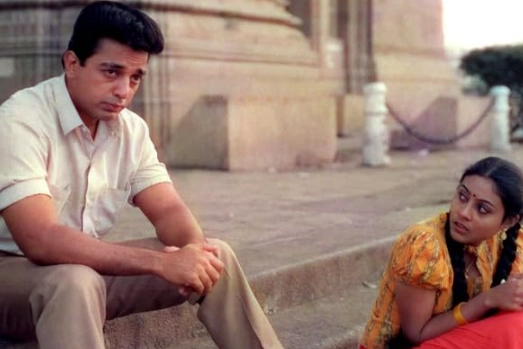
The city in South Indian cinema functions not just as a backdrop, but as a living character that shapes class dynamics, cultural identity, and character arcs within the film’s narrative. Cities in South Indian cinema serve as dynamic characters, shaping the identity, class struggles, and cultural pulse of the stories.Tamil and Telugu cinema have frequently turned their gaze toward Mumbai’s migrant and industrial underworlds—most notably in Mani Ratnam’s Nayakan (tracing a Tamil immigrant's rise in Bombay) and Pa. Ranjith’s Kaala, which centers on land rights and anti-displacement struggles in the Dharavi slums. Nayakan (1987), starring Kamal Hasan shows him in the title role of Velu Naickar who witnesses the brutal murder of his father, kills a corrupt policeman and escapes to Mumbai only to become a notorious gangster. Even after all these years, this epic gangster drama provides an engrossing experience mainly due to the brilliant writing and direction of Mani Ratnam and a mind-blowing, award-worthy performance by Kamal Hasan which includes his magical transformation through make-up.. The story is said to have been loosely based on Mumbai’s underworld kingpin Varadarajan Mudaliar and is narrated over different time-zones through his life. It features in Time Magazine’s 100 films of all time. The film's plot has been compared to that of Ingmar Bergman's Wild Strawberries (1957)] and Federico Fellini's 8½ .
Kaala (2018) in Tamil is an action drama directed and co-written by Pa. Ranjith and produced by Dhanush and Subaskaran Allirajah under the banners of Wunderbar Films and Lyca Productions. The film stars Rajinikanth in the titular role, alongside Nana Patekar, Eswari Rao, Huma Qureshi (in her Tamil debut), Samuthirakani, Pankaj Tripathi, Anjali Patil, K. Manikandan, Dileepan, Nitish Veera, Sampath Raj and Ravi Kale. The film follows Karikalan "Kaala", the leader of Dharavi, who tries to save his land from getting seized and his people from being evicted by Haridev, a ruthless minister. Critics opined that. such is the overpowering screen presence of his cinematic charisma in every frame of the film. The film works big time as Pa. Ranjith has made the film on a grand scale, in a riot of colors, with superbly choreographed action scenes. All this comes with top-of-the-line techno-finesse, perhaps the best ever in Tamil cinema.
Film scholar Madhuja Mukherjee adds that it is important to study the cityscape or the structural changes that occur when immigration happens, or the physical shifts that take place (with globalization of the economy and the culture) when flyovers, multi-storied buildings, or shopping malls are built by doing away with the existing habitat of the original residents – old houses, parks, water bodies, etc. Or, when neon signs, digital bill boards are erected like patchworks in the blue sky. Suddenly, the familiar spaces, the narrow lanes and by-lanes, the grocer’s shop across the road, the old house build by ancestors are practically devoured by other geometric structures that invest the city with a kind of socio-political rebirth born out of the ‘scapes’ described by Appadurai. The nostalgia is tempered with a sense of history.
Since 2000, the ‘Bombay’ genre of films set a trend that focusses on up market, urban metro life against a volatile and explosive environment in a constant state of flux. This has extremely powerful political connotations woven intelligently, almost naturally into its commercial script. Mani Ratnam’s Bombay. shows how a Hindu-Muslim marriage can not only end happily, but also unite two families. It points out that a communal riot does not discriminate between and among its victims on grounds of faith. A eunuch rescues the twin sons during the Mumbai riots. The eunuch does not have a ‘communal’ label attached to her identity.
Madhur Bhandarkar’s Page 3 shed light on how the media is manipulated by celebrities and event managers to ‘manufacture’ news that sells rather than news that informs and educates. His Chandni Bar is a study of the nexus between the Mumbai underworld, the pimps and the bar owners who conspire to exploit bar girls under the pretence of giving them a livelihood. Traffic Signal explores life lived on the fringes of Mumbai’s traffic signals. The workforce could compare favourably with that of any average MNC. Men, women and children are thrown together through destiny and hunger. Among these are beggars– lepers, eunuchs, and handicapped. There are street urchins with a duster in hand rushing in to wipe the dashboards of cars. Drug addicts, flower and fruit sellers, young boys selling pirated bestsellers, sunscreens, sunglasses, etc. and coarse-tongued prostitutes who line the traffic signals dot the film. Bhandarkar’s gift lies in discovering the underbelly of a megalometropolis like Mumbai and laying it bare He touches places and people we are not even aware of.
Anurag Basu’s Life in a Metro is a roller-coaster ride of emotions running a race against each other, against time, against people who may or may not be your near and dear ones. Malls, multiplexes, cars, metros, there is just no stopping an Indian city from growing – vertically, horizontally, financially. This also means increasing distances between and among people, among the Jumping Jacks and the Peeping Toms and the Plane Janes and the Dumb Blondes. Does it make a political statement? Yes, it does through the collage it presents of lives of a few Mumbaikars trapped within a complex world of one-upmanship. It shows the negative side of a materialistic world where emotions fade out as money and matter come in.
The city, in its modern labyrinthine form, offers the ideal environment for a film that combines several genres in one without confusion. It can tell not one, but several stories of different people who may or may not meet at any point, yet, are affected by the city they live in, albeit in different ways. Can they cope with the stress and the strain the city places them under? Do they cope? How and in what manner? These questions are raised, and a few answered as well, in Nishikant Kamath’s Mumbai Meri Jaan. The Mumbai people have the rare talent of absorbing everything – good, bad, ugly and indifferent. Whether they absorb by swallowing, or chewing, or by lingering over it and savouring it in a leisurely fashion, is beside the point. They are like sponges if they are softhearted and shock absorbers if they are tough. Toughness comes almost naturally to the Mumbaikar. Mumbai Meri Jaan brings this alive on celluloid.
Comparatively recent film that offered a multi-layered image of contemporary Mumbai is Kiran Rao’s Dhobi Ghat (2011). It is about four lives that randomly connect in Mumbai. There are fleeting moments of happiness and pain and the eventual realization that the journey never ends. The struggle to survive and to connect is eternal. Does the city shape these lives and their destinies? Or do these four men and women influence the changing character of the city? One is a reclusive artist, arrogant and non-committal. One is a handsome young dhobi who dreams of making it as an actor. One is a NRI investment banker who wishes to switch lanes to become a photographer/filmmaker. The fourth, the most interesting among them who sort of brings them together is Yasmin, a young girl who committed suicide. Cinematographer Tushar Kanti Ray constructs a rich and intimate portrait of locations that are foreign to the mass urban audience even in Mumbai. Sometimes the locations take over and the characters become secondary. Sometimes, it is the other way round.
Cinema is a potent medium for defining the way we think about cities whether it is the futuristic cityscape of Fritz Lang's Metropolis or the realism of Rosellini's war-torn Rome Open City. The city in cinema offers both a real and imaginary space. Wim Wenders’ Wings of Desire (1987) is one of cinema's most hauntingly beautiful city symphonies that transcends concrete barriers to explore a Berlin of the imagination. Cinema expresses dystopias of urbanism rather than utopias, which echo the current preoccupations of urban development.