In the name of God
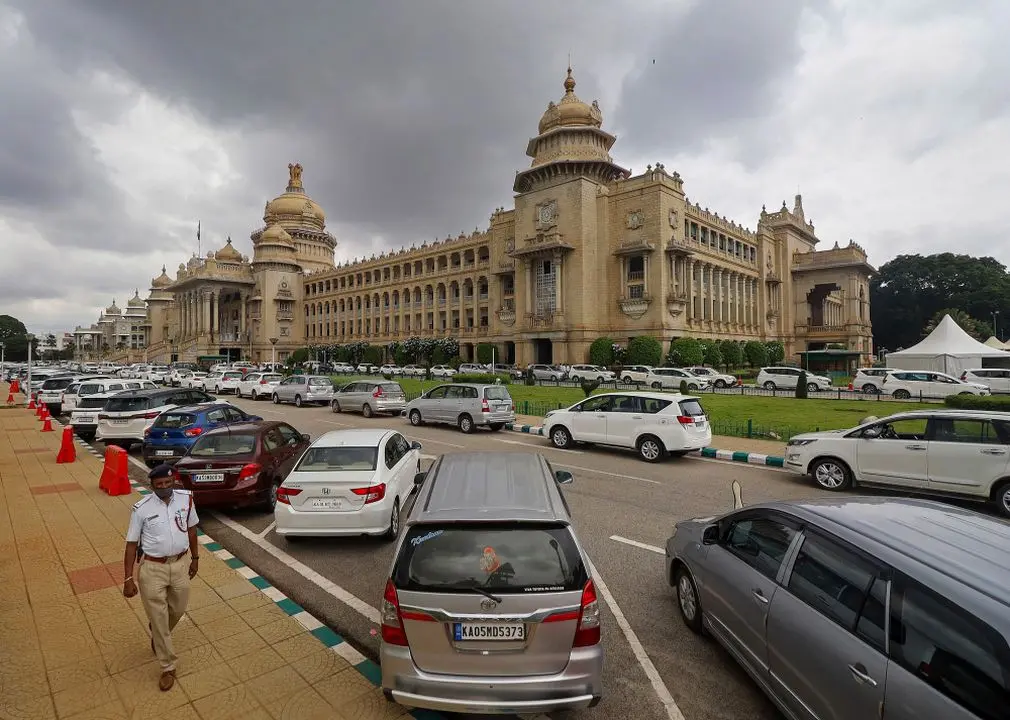
Every morning, on my way to my university, I crossed the grand Vidhana Soudha in Bengaluru, a magnificent edifice epitomising governance and legislative authority of Karnataka. And above the entrance, in bold, commanding letters, was written: "Government work is God's work." Initially, the phrase sounded more rhetorical, even quaint. Yet with weeks turning into days, it began to linger in my thoughts. What does it mean, then, to conflate governance with divine purpose? What kind of "God" are we invoking here?
It seems to require a more ethically sound compass in guiding action by the government toward ideals of justice, compassion, and fairness. However, viewed through the light of reality, the words seem so vapid. It is an etching upon stone starkly at odds with the chaotic and sometimes indifferent realities of governance in India and beyond.
For example, Manipur, a state battered by ethnic conflicts and humanitarian crises lay there to rot as the government's response plodded along unsteadily, the anguish and agony of its people met with deafening silence by those who wield power. Callousness doesn't feel very divine after all in such moments where life hangs by a hair's breadth, meaningful intervention being what is called for.
"A government that hears no cries and sees no tears becomes deaf to its own humanity." If governance is really "God's work", then where's the compassion, the sense of urgency, or justice?
At the very least, the governments behave like gods and rather than servants of a greater aim who demand allegiance, presume an aura of infallibility with which they use their rule, and silence dissent. Power belongs to the people and not to the ruling class and this real power is unrealised when citizen grievances are drowned out by bureaucracy or altogether ignored.
Public protests are considered disturbances and not cries for justice. Their promises are made with great passion but delivered in mediocrity, if at all.
Think of the ploys of poverty relief and jobs promised by the current governments. Doubtless, there is some progress, such as with schemes like Digital India and sanitation improvement. But the ghost of unemployment looms menacingly in the air. The marginalised take on the burden of these failed promises, creating another chasm between rhetoric and reality. And this is not an Indian phenomenon alone. I believe that the true measure of a society lies not in its wealth but in the worth it grants to its weakest.
Governance is always under tension around the world, idealism to execution. One such great example is the United States under Donald Trump: policies against immigrants and minorities lit a fire of fear in many who thought to leave the land promised to them as one of freedom. One cruise line is infamous for a four-year trip to escape his administration.
Government establishments meant to protect their citizen's wellbeing in most instances are the one fueling uncertainty and mistrust. If governance is to be "godly," why does it often seem cold, unjust, and unkind?
The gravest contradiction is perhaps in the injustices against justice itself. More than 134,000 people stand in jail before they are ever tried or convicted in India. Some of them have languished for five-plus years without judgement.
Powerful people go scot-free on account of money, influence, or legal wizardry. Such injustice eats away at faith-not just in governance but in the moral fabric of society. If this is "God's work," it's a pretty frightening representation of a god. We have to understand that a society's morality is found not in the triumphs of the powerful, but in its refusal to forsake the powerless.
"A society's greatness is not measured by the towers it builds but by the shadows it shelters." This is the new, befitting thought that truly points out the fact that governance belongs to the unseen, the unheard, and the forgotten.
This erosion of faith in institutions can be starkly profound. When governments fail to uphold justice or equity, they don't just lose their citizens' trust; they undermine the very ideals they proclaim to serve. Cynicism creeps not just toward governance but toward the very idea of a moral, higher order itself. If "God's work" materialises as negligence, exploitation, and broken promises, who would believe in it?
Yet, the Vidhana Soudha's inscription continues to haunt us because it challenges our minds to think of governance as could be, rather than how it is. It challenges us to demand more from our leaders, keep them under our thumbs, and reassert the power of people. In a manner of speaking, perhaps the inscription is both an aspiration and a reminder that governance has to rise to the divine responsibility of treating its people fairly and empathetically.
To put it in a nutshell, governments have indeed gained some achievements. Roads have been built, villages electrified, welfare schemes introduced. But behind every achievement, there are the muted screams of the voiceless and the invisible-the marginalised communities whose sufferings remain unheeded.
True progress is not measured in milestones but in the dignity restored to every forgotten life. Real governance will be above corruption, having put dignity and humanity at its foundation. It will listen to voices that are silently screaming, a voice rather than suppressing it with a threat or a bribe.
And every time I pass Vidhana Soudha on my daily rounds, it does not feel like a statement of fact but more of an unmet dream-the call for governments and citizens alike to embody what justice, compassion, and accountability represent. Until that day, those proud bold letters will stay in stone haunting reminders of what could be and what is yet to be achieved.
The author is an undergraduate student in International Relations, Peace and Public Policy, and Journalism at St Joseph's University. Views expressed are personal.